

A field-deployable lateral flow assay for rapid and sensitive detection of nanoplastics
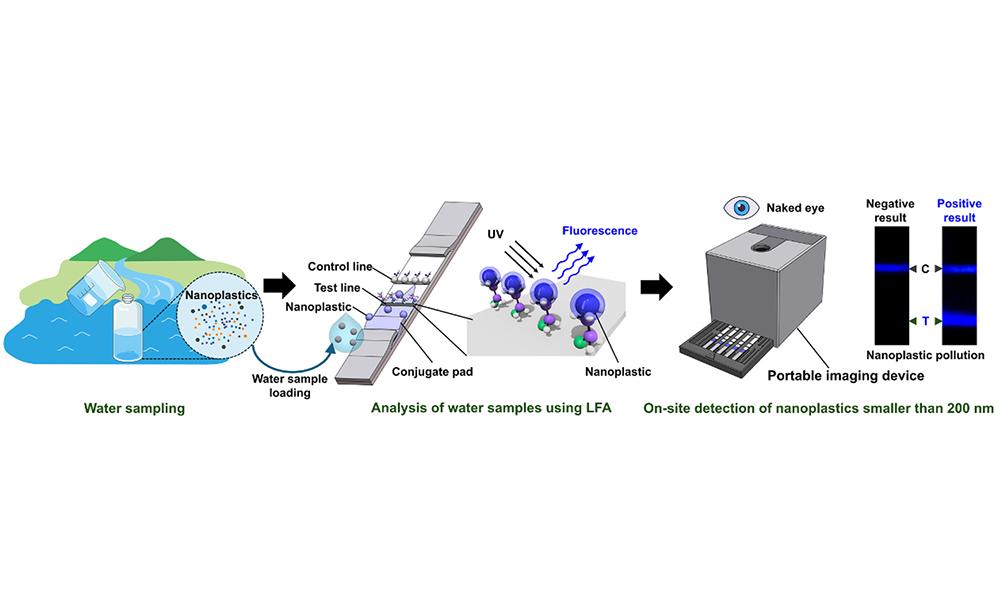
Plastic pollution has emerged as a global concern, with nanoplastics posing a distinct threat due to their small size, high mobility, and persistence. However, conventional nanoplastic detection techniques often rely on sophisticated instruments and extensive preprocessing, limiting their on-site applicability. This study aimed to develop a rapid and portable lateral flow assay (LFA) for on-site detection of nanoplastics smaller than 200 nm in environmental water samples. Here, we present a fluorescence-based LFA capable of detecting five common polymer types–polystyrene, low-density polyethylene, polypropylene, polyethylene terephthalate, and polyvinyl chloride–within 10 min. The assay achieved detection limits ranging from 9.3–163.9 μg/L, depending on polymer type and particle size. It demonstrated excellent selectivity against common interferents such as bacterium and natural organic matter, and maintained robust performance in complex matrices including bottled water and tea extract. To validate real-world applicability, nanoplastic mixtures were spiked into river water and seawater at concentrations of 3.7 × 10²–3.7 × 10⁴ μg/L, and all five polymer types were successfully detected. These results demonstrate that the developed LFA enables rapid (<10 min), on-site detection of multiple nanoplastic types in real environmental water samples, providing a practical and field-deployable solution to improve monitoring and management of nanoplastic contamination.
- Authors (Pusan National University):
· First author: Yunsoo Chang (Department of Microbiology),
· Corresponding author: Eun-Hee Lee (Department of Microbiology, Institute for Future Earth)
- Title of original paper: A field-deployable lateral flow assay for rapid and sensitive detection of nanoplastics
- Journal: Journal of Hazardous Materials
- Web link: https://doi.org/10.1016/j.jhazmat.2025.139662
- Contact e-mail: leeeh@pusan.ac.kr
 950이은희교수1.jpg
(184KB)
950이은희교수1.jpg
(184KB)