

Beyond Antibiotics—A Paradigm Shift Toward Bacteria-Control-Centric Therapies
Novel extracellular vesicle platform helps polymyxins kill multidrug-resistant gram-negative bacteria at lower and potentially safer doses
Multidrug resistance is making life-saving antibiotics increasingly ineffective, leaving doctors with a few options to treat deadly bacterial infections. A new study has identified a bacterial peptide that reprograms multidrug-resistant Escherichia coli, making it vulnerable to last-resort polymyxin antibiotics. The researchers also developed an extracellular vesicle-based delivery platform that restored antibiotic activity at lower doses while reducing toxicity, introducing a new strategy that manipulates bacteria's own biology to fight drug resistance.
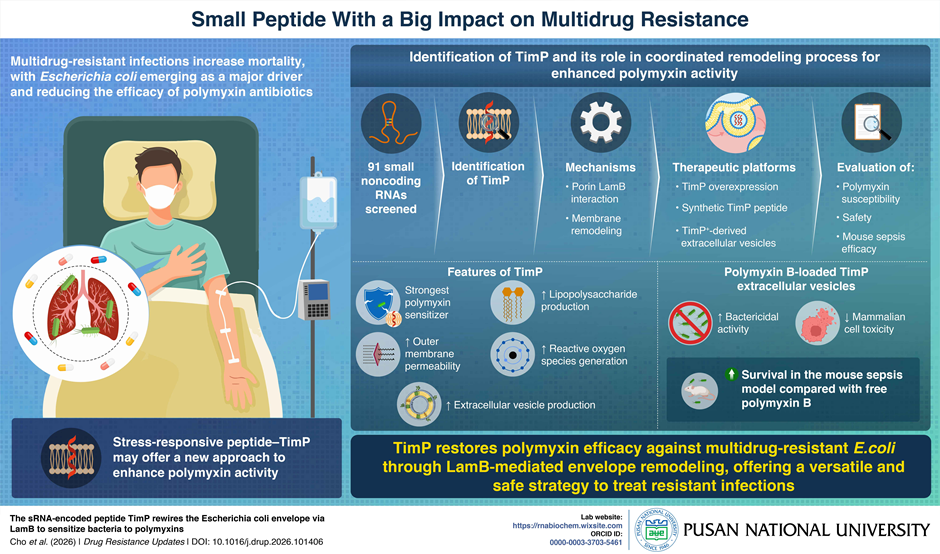
Image title: Engineered bacterial vesicles restore the power of last-resort antibiotics
Image caption: Researchers developed extracellular vesicles carrying the bacterial peptide TimP and the antibiotic polymyxin B (PMB), creating a targeted drug delivery platform called PMB@TimP EVs. The vesicles reprogram multidrug-resistant Escherichia coli to become more vulnerable to PMB, allowing the antibiotic to work at lower doses.
Image credit: Prof. Kwang-sun Kim from Pusan National University, Republic of Korea
License type: Original Content
Usage restrictions: Cannot be reused without permission.
Antimicrobial resistance is one of the world's most alarming public health challenges, because the multidrug-resistant (MDR) gram-negative bacteria increasingly render even last-line antibiotics ineffective, leading to substantially higher mortality rates. Polymyxins are a class of antibiotics that remain among the few treatment options available for severe infections caused by resistant Escherichia coli. But their widespread use is limited by serious side effects, including kidney and nerve toxicity.
Driven by this gap, researchers have now developed an innovative strategy that makes bacteria more susceptible to these antibiotics, potentially allowing doctors to use lower, safer doses without sacrificing effectiveness. This transformative approach shifts the focus from antibiotic-centric to bacteria-control-centric therapy rendering bacteria more susceptible to the antibiotics by facilitating membrane gateways that enhance antibiotic uptake.
The research team was led by Professor Kwang-sun Kim from the Department of Chemistry and Chemistry Institute for Functional Materials, Pusan National University, Republic of Korea. This study was made available online on April 22, 2026, and was published in Volume 87 of the journal Drug Resistance Updates on July 01, 2026.
"With the development of new antibiotics failing to keep pace with bacterial evolution, maximizing the efficacy of existing resources will become the primary strategy to bridge the therapeutic gap in clinical settings," says Prof. Kim
Rather than designing another antibiotic to kill bacteria directly, the team identified a naturally occurring peptide called TimP, encoded by a bacterial small non-coding RNA (sRNA) RyfA, that prompts bacteria to reorganize their own outer membrane. This remodeling creates openings that allow polymyxins to penetrate the bacterial envelope more effectively.
The team screened 91 bacterial sRNAs to identify molecules capable of increasing sensitivity to polymyxins and identified RyfA, within which peptide TimP was responsible for dramatically enhancing antibiotic susceptibility. Through structural prediction and in vitro validation, we showed that TimP binds to the outer membrane protein called porin LamB, triggering widespread changes in the bacterial envelope. These changes include increased membrane permeability, higher production of reactive oxygen species, and greater release of extracellular vesicles.
The researchers then engineered extracellular vesicles (EVs) carrying both TimP and polymyxin B (PMB), creating a targeted delivery platform called PMB@TimP EVs. Acting as a "Trojan-horse drug delivery system," the vesicles delivered the antibiotic directly to bacteria while simultaneously making the bacterial membrane easier for the drug to penetrate.
Further analysis showed that PMB@TimP EVs enhanced bacterial killing, remained stable across a broader pH range, and caused minimal toxicity to mammalian cells compared with free PMB. In a murine model of sepsis caused by MDR E. coli, the engineered vesicles improved survival at doses where free PMB failed to confer protection against the infections. Additional safety studies found no abnormal accumulation of the treatment in major organs, while inflammatory markers and liver enzymes remained within normal physiological ranges.
The researchers also found that LamB, the bacterial outer membrane protein required for TimP activity, is conserved in Salmonella Typhimurium. According to the team, this suggests the platform could potentially be adapted to combat a wider range of multidrug-resistant gram-negative bacteria beyond E. coli.
“PMB@TimP EVs can serve as a potent adjuvant therapy for patients suffering from sepsis, pneumonia, or urinary tract infections caused by MDR gram-negative bacteria, significantly improving recovery rates,” says Prof. Kim.
Although the findings are promising, the researchers emphasize that the work has so far been demonstrated in murine models. Further studies will be needed before the platform can be tested in human clinical trials, including investigations into long-term safety, manufacturing, and effectiveness against a broader range of resistant bacterial infections.
"Within 5-10 years, this platform could be integrated into standards for combating MDR pathogens. This will ultimately reduce the over-prescription of antibiotics and contribute to a more sustainable healthcare system," states Prof. Kim.
If future clinical studies confirm these findings, the platform could help extend the lifespan of existing antibiotics, reduce the need for high-dose polymyxin treatment, and provide clinicians with a new strategy for treating life-threatening infections caused by multidrug-resistant gram-negative bacteria.
Reference
|
Title of original paper: |
The sRNA-encoded peptide TimP rewires the Escherichia coli envelope via LamB to sensitize bacteria to polymyxins |
|
Journal: |
Drug Resistance Updates |
|
DOI: |
About Professor Kwang-sun Kim
Dr. Kwang-sun Kim is a Professor of Chemistry at Pusan National University (PNU), Korea. His research focuses on understanding antibiotic resistance and developing innovative antimicrobial platforms, including nanomaterials and extracellular vesicle-based vaccines and therapeutics. He received his Ph.D. in Biochemistry from KAIST in 2004 and completed postdoctoral training at KAIST and in Stanley N. Cohen’s lab at Stanford University. From 2009 to 2015, he served as a Senior Researcher at the Korea Research Institute of Bioscience and Biotechnology (KRIBB). His work integrates biomedical and environmental applications of advanced vaccine and antimicrobial technologies associated with multiomics and small noncoding RNAs.
Lab:
https://rnabiochem.wixsite.com
ORCID ID:
0000-0003-3703-5461
 PURCS_190_Infographic_final.jpg
(1MB)
PURCS_190_Infographic_final.jpg
(1MB)