

Study Explores the Hedging Capability of Cryptocurrencies in Turbulent Markets
A quantile analysis study identifies some green cryptocurrencies as better transmitters of volatility compared to green assets, challenging traditional assumptions
With the expansion of sustainable investments, understanding how green financial assets interact has become increasingly important. A quantile analysis of market data, under different market situations, revealed that green cryptocurrencies, particularly Cardano and Stellar, often act as major transmitters of risk, while traditional green assets tend to absorb rather than mitigate market shocks. This study highlights the evolving nature of risk management within sustainable finance.
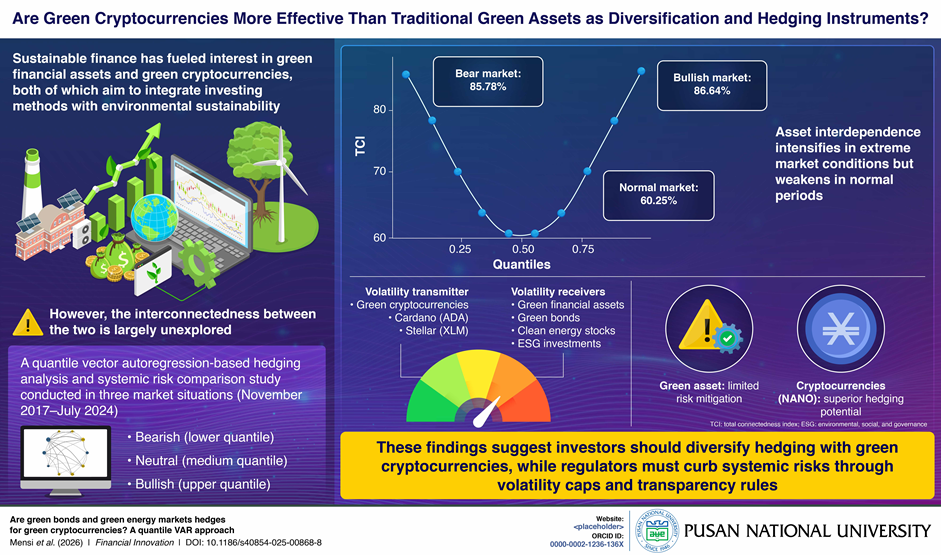
Image title: Are Green Cryptocurrencies More Effective Than Traditional Green Assets as Diversification and Hedging Instruments?
Image caption: Challenging traditional assumption, certain green cryptocurrencies such as Cardano and Stellar act as major transmitters of market volatility, while green bonds, clean energy, and ESG investments often absorb these shocks.
Image credit: Professor Sang Hoon Kang from Pusan National University, Korea
License type: Original Content
Usage restrictions: Cannot be reused without permission
The rapid growth of sustainable finance in recent years has fuelled interest in green investment, ranging from green bonds and Environmental, Social, and Governance (ESG) funds to energy-efficient cryptocurrencies. While these assets are often grouped under the broader umbrella of green finance, their interaction during periods of market stress remains largely unexplored.
Investors usually prefer ESG funds and green bonds on the assumption that they provide both ethical and financial security. Green cryptocurrencies, which rely on energy-efficient consensus mechanisms such as Proof-of-Stake and related protocols, have emerged as alternatives to traditional cryptocurrencies, which are known for their high energy consumption. Whether these assets complement one another or amplify risk remains unclear.
A new study, led by Professor Sang Hoon Kang of Pusan National University, examined the interconnectedness between seven green cryptocurrencies and three major green financial benchmarks. Using daily market data spanning November 2017 to July 2024, which includes the COVID-19 pandemic period, the team investigated how risk is transmitted across sustainable financial markets under different market conditions. The findings of this study were published in Volume 12 of the Financial Innovation journal on June 09, 2026. “As green cryptocurrencies are getting more integrated into sustainable investment portfolios, we wanted to understand their hedging capability and how it differs from traditional green finance options,” explained Prof. Kang.
The researchers employed a quantile vector autoregression x-framework, an advanced statistical approach that captures market behaviour during bearish (lower quantiles), normal (medium quantiles), and bullish (higher quantiles) conditions. Unlike conventional methods that focus on average market relationships, this approach allows the dynamics of risk transmission to be examined during periods of extreme stress and exuberance.
The analysis revealed a striking U-shaped pattern in market connectedness. During relatively stable market conditions, interactions between green cryptocurrencies and traditional green assets were moderate, allowing for meaningful diversification opportunities. However, connectedness increased sharply during both market downturns and market booms. Under these extreme conditions, assets became far more synchronized, reducing the benefits of diversification and increasing the potential for financial contagion.
Portfolio analysis also suggested that traditional green assets provide only limited hedging effectiveness against green cryptocurrency volatility. Among the cryptocurrencies studied, Cardano and Stellar emerged as the most influential transmitters of volatility across the sustainable finance ecosystem. In contrast, green bonds, clean energy indices, and ESG investments consistently acted as net receivers of volatility, absorbing disturbances generated elsewhere in the system.
These findings challenge the traditional perception that green financial assets function as reliable safe-haven investments. Although green bonds and ESG-related assets are often regarded as defensive portfolio components, the results indicate that they may remain vulnerable to shocks originating in green cryptocurrency markets, particularly during periods of heightened uncertainty.
The study further showed how major global events strengthened these connections. Market interconnectedness increased during the COVID-19 pandemic and remained elevated during subsequent geopolitical disruptions. As crises intensified, diversification benefits weakened and risk spillovers became more pronounced across sustainable asset classes.
As green cryptocurrencies become increasingly integrated into investment portfolios, evidence of asymmetric spillovers will be important for preventing investors from assuming that all “green” assets are automatically safe or diversifying. “While investors may need to adopt more dynamic portfolio strategies, regulators should consider measures aimed at monitoring and managing systemic risks associated with emerging green digital assets,” explained Prof. Kang.
The study provides new evidence that sustainability-focused investments are not immune to financial contagion. As the green finance ecosystem continues to expand, the findings of this study can help investors, fund managers, and policymakers in developing monitoring tools, volatility thresholds, disclosure standards, and cross-border regulatory x-frameworks for green digital assets.
Reference
|
Title of original paper: |
Are green bonds and green energy markets hedges for green cryptocurrencies? A quantile VAR approach |
|
Journal: |
|
|
DOI: |
About the author
Dr. Sang Hoon Kang is currently working as a professor at the Department of Business
Administration, Pusan National University. He received his Ph.D. degree from UniSA Business University of South Australia. He is interested in financial time-series analysis, emerging stock markets, Islamic finance, risk management, energy finance, and financial connectedness network. He has contributed in more than 150 research articles in reputed journals including Energy Economies, Resource Policy, Finance Research Letters, International Review of Financial Analysis, Pacific-Basin Finance Journal etc.
ORCID Id: https://orcid.org/0000-0002-1236-136X
 PURCS_203_Infographic_final.jpg
(2MB)
PURCS_203_Infographic_final.jpg
(2MB)