

Study Highlights Federated and Reinforcement Learning for Natural Language Processing
This comprehensive review shows how combining these paradigms can pave the way for emerging intelligent systems
Modern natural language processing (NLP) systems face challenges in adaptability, privacy, and require immense computational resources, limiting real-world deplorability beyond the cloud. A new comprehensive review analyzes how recent paradigms of federated learning, reinforcement learning and their integration into NLP can address these issues and become the foundation of emerging intelligent systems (EIS), making AI more reliable, safer and deployable on grounded devices.
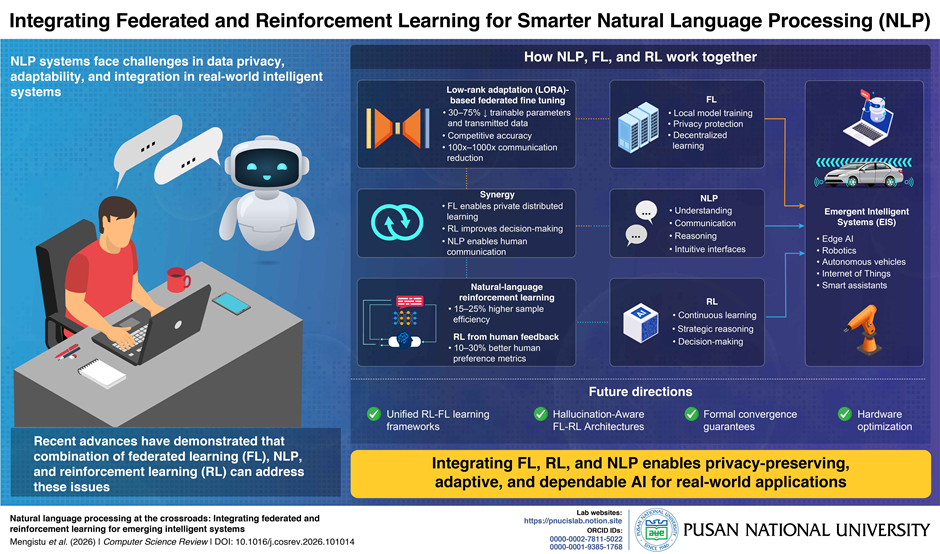
Image title: Integrating Federated and Reinforcement Learning for Smarter Natural Language Processing (NLP)
Image caption: The review highlights how NLP, FL and RL can become the foundation for emerging intelligent systems with adaptability, reliability, privacy, scalability and security, moving NLP beyond the cloud.
Image credit: The authors
License type: Original Content
Usage restrictions: Cannot be reused without permission
Natural language processing (NLP), a branch of artificial intelligence, enables computers to understand and generate human language. Large language models (LLMs) now power everyday applications such as chatbots, virtual assistants, and translation tools. Despite these advances, modern NLP systems still face important challenges, including protecting user privacy, adapting to changing environments, and operating efficiently on resource-limited devices.
A recent review led by Professor Taewoon Kim and Mr. Tesfahunegn Minwuyelet Mengistu from the Department of Information Convergence Engineering at Pusan National University, South Korea, explores how integrating three complementary paradigms—Federated Learning (FL), Reinforcement Learning (RL), and NLP—can overcome these limitations and support the development of emerging intelligent systems. The study also presents FL, RL, and NLP as three co-equal, interdependent pillars in a unified x-x-framework. “Today's language models are caught in a privacy–adaptability–deployability trilemma,” explains Prof. Kim. “We show that this trilemma is now breakable, and we offer the first unified taxonomy for combining NLP, federated learning, and reinforcement learning that is absent in previous works.” Their study was made available online on June 8, 2026, and will be published in Volume 62 of Computer Science Review in November 1, 2026.
The review traces the evolution of NLP from rule-based systems to transformer-based LLMs before examining how federated and reinforcement learning address current limitations.
Federated learning tackles one of the biggest concerns surrounding AI: data privacy. Instead of sending sensitive information to a central server, devices or organizations train models locally and share only model updates. This approach protects user data, supports compliance with privacy regulations, and reduces communication costs. The review highlights Low-Rank Adaptation (LoRA)-based federated learning as an efficient strategy for fine-tuning LLMs, reporting up to 100-fold reductions in communication costs and 30–75% reductions in transmitted data and trainable parameters compared with conventional methods.
Reinforcement learning, particularly reinforcement learning from human feedback (RLHF), enables language models to improve through feedback, resulting in better reasoning, planning, and decision-making. Studies reviewed by the authors show that combining language and reinforcement learning improves sample efficiency by 15–25% and human preference scores by 10–30%.
The review also proposes a six-dimensional taxonomy for integrating NLP, FL, and RL, while quantifying trade-offs between privacy, communication efficiency, and model performance. The authors argue that this combination forms the foundation of next-generation emerging intelligent systems capable of autonomous decision-making in real-world environments. They also highlight an intriguing finding: federated learning and reinforcement learning can both contribute to and reduce AI hallucinations through different mechanisms, emphasizing the need for careful system design.
“The most immediate applications lie wherever data is too sensitive to move yet too valuable to ignore,” notes Mr. Mengistu. “Hospitals could privately train clinical language models on sensitive patient notes. At home, language models can run entirely on local hardware. Moreover, finance, law, and defense can utilize offline domain-specific models. Importantly, this would make privacy a structural property of AI systems, redistributing who gets to build AI.”
Although challenges remain, this review shows how integrating NLP, federated learning, and reinforcement learning could enable safer, more adaptive, and privacy-preserving AI systems for healthcare, robotics, autonomous vehicles, and Internet of Things devices.
Reference
Title of original paper: Natural language processing at the crossroads: Integrating federated and
reinforcement learning for emerging intelligent systems
Journal: Computer Science Review
DOI: 10.1016/j.cosrev.2026.101014
About Professor Taewoom Kim
Prof. Taewoon Kim is a professor in the Department of Information Convergence Engineering at Pusan National University, Korea. His research covers modeling, optimization, and protocol design for wireless systems, including WLANs, IoT/sensor networks, HetNets, and C-RANs, as well as cloud/edge computing and reinforcement learning-based autonomous agent control. He was previously an assistant professor at Hallym University and has also served as a research engineer at the Telecommunications Technology Association. He received his B.S. from Pusan National University, his M.S. from the Gwangju Institute of Science and Technology, and his Ph.D. in Computer Engineering from Iowa State University in 2018.
Lab: https://pnucislab.notion.site
ORCID: 0000-0002-7811-5022
About Tesfahunegn Minwuyelet Mengistu
Tesfahunegn Minwuyelet Mengistu is a Computer Engineering Ph.D. candidate at Pusan National University, South Korea. His research focuses on Edge AI, Federated learning, Reinforcement learning, Transfer Learning, and privacy-preserving ML for IoT and WSNs. He addresses challenges like non-IID data, dynamic environments, and system heterogeneity, with applications spanning healthcare AI, assistive tech, and OCR for low-resource languages. He earned his B.Sc. and M.Sc. degrees in Computer Science and Software Engineering from Bahir Dar University in 2017 and 2019, respectively. He also served there as a lecturer and researcher from 2017 to 2023.
ORCID: 0000-0001-9385-1768
 PURCS_206_Infographic_final.jpg
(1MB)
PURCS_206_Infographic_final.jpg
(1MB)