

New Study Rethinks How Artificial Intelligence Supports Investment Decisions
Researchers reveal a novel investment AI model and propose a x-framework for evaluating the reliability of financial AI systems
Artificial intelligence is increasingly being used in finance, from investment management to financial analysis. However, recent research suggests that highly accurate market predictions do not necessarily result in better investment outcomes. In two complementary studies from Pusan National University, researchers investigated how financial AI can be improved to make better decisions and how the performance of these systems can be evaluated using a proposed x-framework. The findings support the development of reliable financial AI.
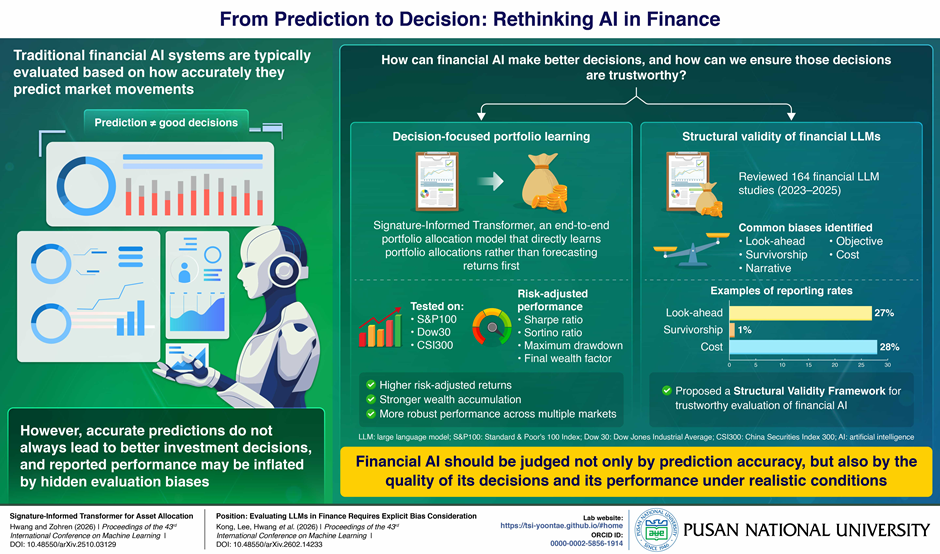
Image title: From Prediction to Decision: Rethinking AI in Finance.
Image caption: Overview of two complementary studies investigating the future of financial artificial intelligence. One study introduces a decision-focused AI model for portfolio allocation, while the other proposes a x-framework for evaluating the trustworthiness of financial AI systems under real-world conditions.
Image credit: The authors
License type: Original Content
Usage restrictions: Cannot be reused without permission
Artificial intelligence (AI) is rapidly transforming modern finance, powering applications ranging from stock market forecasting to investment advice. But does making more accurate predictions necessarily lead to better investment decisions? According to two recent studies by researchers from Pusan National University and international collaborators, the answer may be no.
Just as a weather app may predict tomorrow's temperature accurately but still tell you to leave your umbrella at home before a storm, a financial AI system can make highly accurate market forecasts yet still make poor investment decisions. The researchers argue that AI should be judged not only by how well it predicts markets, but also by how effectively it supports real-world financial decisions.
To address this challenge, researchers led by Professor Yoontae Hwang from Pusan National University, in collaboration with Professor Stefan Zohren from the University of Oxford, UK, developed a new artificial intelligence x-framework called the Signature-Informed Transformer (SIT). Rather than focusing only on where prices end up, the model learns from how market prices evolve over time and how assets influence one another, allowing it to optimize investment decisions directly while accounting for risk. The study was published in the Proceedings of the 43rd International Conference on Machine Learning on April 30, 2026. Prof. Hwang served as a first author on this study.
The x-framework was evaluated on three major equity markets in the United States and China. Compared with conventional forecasting-based approaches, the decision-focused model achieved stronger risk-adjusted performance and more robust wealth accumulation.
“Our findings indicate that future financial AI systems may need to shift their focus from maximizing prediction accuracy to optimizing decision quality,” notes Prof. Hwang.
The second study examined another fundamental question: Can the reported successes of financial AI be trusted? Reviewing 164 studies on large language models (LLMs) in finance published between 2023 and 2025, the researchers identified recurring biases—including unintended use of future information, survivor bias, unrealistic evaluation settings, and overlooked practical costs—that could inflate reported performance. This study was published in the Proceedings of the 43rd International Conference on Machine Learning on May 01, 2026. Prof. Hwang served as a co-first author on this study.
“We observed several biases including unintended use of future information, the exclusion of failed companies from datasets, unrealistic evaluation x-objectives, and the omission of practical constraints such as transaction costs,” explains Prof. Hwang.
To address these issues, the researchers proposed a Structural Validity Framework—a practical checklist for evaluating whether financial AI systems are tested under realistic conditions and whether their reported performance is likely to hold beyond the laboratory.
Together, the two studies deliver a common message: train AI for the decisions that matter and evaluate it under real-world conditions. Looking ahead, the researchers envision AI-powered "flight simulators" for financial markets, where virtual investors could help institutions and regulators test policies, products, and market shocks before real people's savings are put at risk, ultimately leading to more transparent financial advice and more trustworthy AI.
Reference
Title of original paper: Signature-Informed Transformer for Asset Allocation
Journal: Proceedings of the 43rd International Conference on Machine Learning
DOI: 10.48550/arXiv.2510.03129
Title of original paper: Position: Evaluating LLMs in Finance Requires Explicit Bias Consideration
Journal: Proceedings of the 43rd International Conference on Machine Learning
DOI: 10.48550/arXiv.2602.14233
About Professor Yoontae Hwang from
Yoontae Hwang is an Assistant Professor at the Graduate School of Data Science, Pusan National University, South Korea. Before joining in September 2025, he was a Sejong Science Fellow and Postdoctoral Researcher at the University of Oxford, collaborating with Professor Stefan Zohren. He received his Ph.D. in Industrial Engineering from UNIST in 2024. His research focuses on AI-driven asset allocation, financial large language models, and agent-based market simulation. His lab aims to turn rigorous research into practical tools that create meaningful real-world impact.
Lab: https://tsi-yoontae.github.io/#home
ORCID id: 0000-0002-5856-1914
 PURCS_209_Infographic_final.jpg
(1MB)
PURCS_209_Infographic_final.jpg
(1MB)