

Pusan National University & Chung-Ang University Develop Next-Generation Self-Renewing Air Filter Coating
Novel dynamic imine bond adhesive technology enhances commercial filters with improved efficiency and durability
Air filters are essential for protecting human health by removing harmful particulate matter from the air. However, conventional filters often struggle to securely retain captured particles, allowing some to detach over time and reducing filtration performance. To address this longstanding challenge, researchers from Chung-Ang University and Pusan National University developed an innovative self-renewing adhesive coating designed to improve particle retention, paving the way for more efficient and durable air filtration technologies.
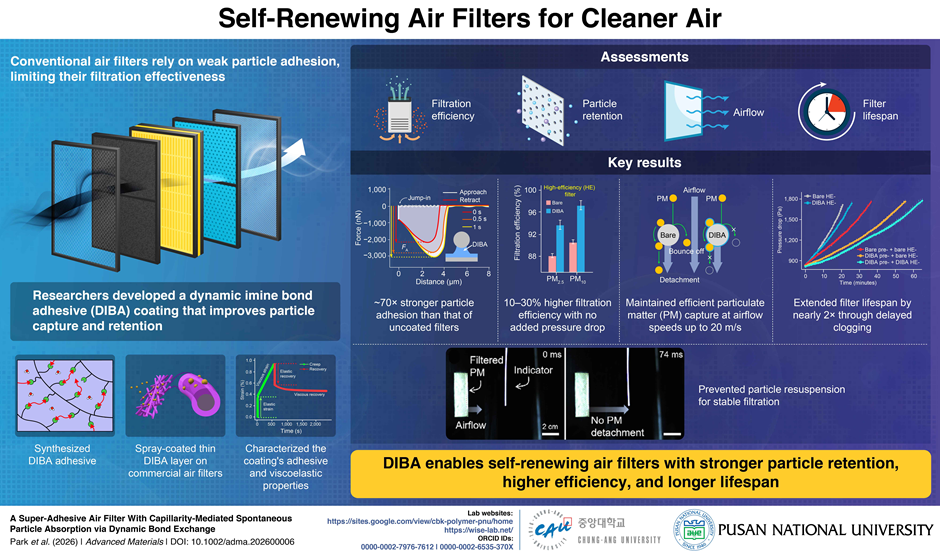
Image title: Smarter Filters for Cleaner Air
Image caption: Dynamic adhesive chemistry enables durable, high-performance air filtration.
Image credit: Professor Sanghyuk Wooh from Chung-Ang University, Republic of Korea and Professor Chae Bin Kim from Pusan National University, Republic of Korea
License type: Original content
Usage restrictions: Cannot be reused without permission.
Breathing clean air is essential for human health, making air filters indispensable in homes, hospitals, workplaces, and industrial settings. However, despite decades of advances in filter materials and design, a major challenge remains. Capturing airborne particles is only half the battle; keeping them securely trapped is equally important. Conventional air filters rely on weak adhesive forces, allowing some captured particles to detach and re-enter the air. This reduces filtration efficiency, shortens filter lifespan, and highlights the need for smarter, more durable air filtration technologies.
To address this challenge, a study led by Professor Sanghyuk Wooh from Chung-Ang University, Republic of Korea and Prof. Chae Bin Kim from Pusan National University, Republic of Korea, developed a dynamic imine bond adhesive (DIBA), a self-renewing coating that combines the stability of a solid with the particle-grabbing ability of a liquid. Synthesized by crosslinking polydimethylsiloxane (PDMS) through dynamic Schiff base chemistry, the coating allows trapped particles to sink into the adhesive layer, continuously exposing fresh sticky surfaces for sustained particle capture. The study was published online in the journal Advanced Materials on April 22, 2026.
The researchers spray-coated a thin DIBA layer onto commercially available air filter media and characterized its chemical, mechanical, and adhesive properties using rheology, Fourier-transform infrared spectroscopy, atomic force microscopy, and microscopy. They then evaluated filtration efficiency, pressure drop, particle resuspension, high-speed airflow performance, and long-term durability.
The DIBA coating significantly improved both particle retention and filtration performance. By forming capillary-driven adhesive bridges around captured particles, it increased particle adhesion by nearly 70-fold while continuously renewing its adhesive surface. This translated into a 10–30% improvement in filtration efficiency across multiple commercial filter materials without increasing pressure drop, upgrading filter performance from minimum efficiency report value (MERV) 6 to MERV 11. The coated filters also maintained efficient particulate matter capture under airflow speeds of up to 20 m/s and delayed pore clogging, extending filter lifespan by nearly a factor of two compared to conventional filters.
The technology also shows strong potential for real-world implementation. Because the DIBA coating can be applied using a simple spray-coating process, it is compatible with existing commercial filter materials, enabling easy integration into current filtration systems. “This technology could improve a wide range of filtration systems where both high capture efficiency and long operational lifetime are important, including HVAC systems, home air purifiers, industrial dust collectors, cleanrooms, automotive cabin filters, and personal protective equipment,” says Prof. Kim.
Looking ahead, the researchers believe the technology could extend beyond air filtration. "The dynamic adhesive concept could enable next-generation filtration systems that capture pollutants more efficiently, require less energy, and operate significantly longer before replacement," says Prof. Wooh. Beyond air filters, the same principles could be adapted for water purification, environmental remediation, dust-free manufacturing, and advanced particle handling.
Overall, the study demonstrates how a simple materials innovation can overcome a longstanding limitation of conventional air filters. By enabling stronger particle retention without compromising airflow, the self-renewing DIBA coating offers a practical path toward cleaner air, longer-lasting filters, and more sustainable filtration systems.
Reference
Title: A Super-Adhesive Air Filter With Capillarity-Mediated Spontaneous Particle Absorption via Dynamic Bond Exchange
Journal Name: Advanced Materials
About Professor Chae Bin Kim from Pusan National University
Prof. Chae Bin Kim is an Associate Professor in the Department of Polymer Science and Engineering at Pusan National University. His research focuses on covalent adaptable polymer networks, thermal management materials, pressure-sensitive adhesives, polymer recycling, and advanced functional composites. Before joining Pusan National University in 2019, he received his Ph.D. in Chemical Engineering from The University of Texas at Austin under the supervision of Prof. Christopher J. Ellison and also conducted postdoctoral research at the Korea Institute of Science and Technology (KIST).
Lab: https://sites.google.com/view/cbk-polymer-pnu/home
OCID: 0000-0002-7976-7612
About Professor Sanghyuk Wooh from Chung-Ang University
Prof. Sanghyuk Wooh is an Associate Professor in the Department of Chemical Engineering at Chung-Ang University. His research focuses on interface and surface engineering, with particular expertise in liquid–liquid and liquid–solid interfaces. His group develops bioinspired liquid-repellent surfaces, surfaces for liquid metals, next-generation high-efficiency air filtration systems, and interface-engineered electrochemical cells. He received his B.S., M.S., and Ph.D. in Chemical and Biological Engineering from Seoul National University, Korea, and completed postdoctoral research at the Max Planck Institute for Polymer Research, Germany.
OCID: 0000-0002-6535-370X
 PURCS_198_Infographic_final.jpg
(1MB)
PURCS_198_Infographic_final.jpg
(1MB)