

Study Advances Solar Desalination with Multifunctional Membrane
Researchers develop an innovative membrane technology to sustainably address challenges associated with desalination
Solar-driven desalination is a promising way to produce freshwater sustainably using sunlight. However, existing systems struggle when desalinating oily seawater because oil fouls their specialized membranes. Now, researchers from Korea and Singapore have collaboratively developed a multifunctional hydrogel membrane that combines oil removal with solar-powered desalination. The membrane achieved over 99.99% oil rejection while maintaining stable and efficient freshwater production, demonstrating a promising strategy for treating real-world oily seawater.
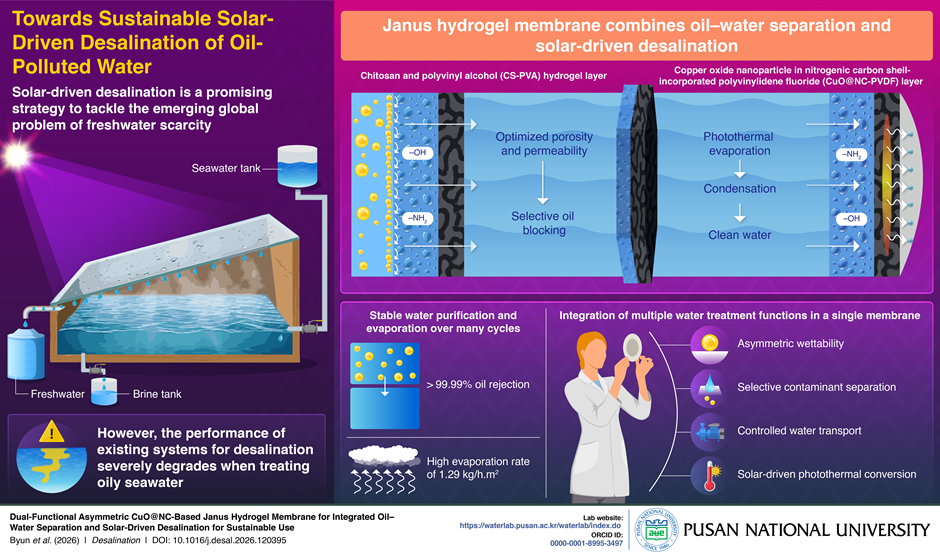
Image title: Double-faced membrane combines two key functions for seawater desalination
Image caption: This innovative design offers a practical and scalable way to harness sunlight for desalinating oily seawater.
Image credit: Professor Sanghyun Jeong from Pusan National University, Republic of Korea
License type: Original Content
Usage restrictions: Cannot be reused without permission.
As the world’s population grows and industry expands, many countries in Africa, the Middle East, and Southeast Asia are facing a freshwater scarcity crisis. Finding sustainable ways to produce clean water has become an urgent priority, and solar desalination may be one of the most promising routes available. By using sunlight to evaporate and purify seawater, this technology could serve as an efficient source of freshwater in areas facing water shortages.
However, seawater contains more than just salt. Coastal waters near ports and industrial areas are often contaminated with oil, which can clog the specialized membranes used in desalination systems. Although many experimental desalination platforms have shown promising results, most have been tested using clean saltwater under laboratory conditions. Thus, it remains unclear how well they would actually perform with real-world seawater.
To address this challenge, a research team led by Professor Sanghyun Jeong from the Department of Civil and Environmental Engineering, Pusan National University, Republic of Korea, has developed a new multifunctional hydrogel membrane for solar-driven desalination. Their study was made available online on June 1, 2026, and will be published in Volume 636 of the journal Desalination on October 15, 2026. Rather than treating oil separation and desalination as separate processes, the researchers designed a single membrane architecture that does both.
The proposed membrane has a ‘Janus’ architecture, meaning it has two sides with different properties. One side is water-attracting (hydrophilic) and made from a chitosan and polyvinyl alcohol hydrogel; it lets water through while repelling oil droplets. The other side is water-repelling (hydrophobic) and contains copper oxide nanoparticles wrapped in a carbon shell, embedded in a nanofiber layer. This side absorbs sunlight, converts it into heat, and drives water evaporation at its surface. Because each layer focuses on one task, oil rejection and heat generation do not interfere with each other, which can happen in single-layer designs.
Experiments revealed that the proposed membrane removed over 99.99% of oil from contaminated seawater while maintaining stable performance against different oil droplet sizes and repeated use. During solar desalination, it achieved an evaporation rate of 1.29 kilograms of water per square meter per hour, which is nearly three times higher than that of a conventional single-layer membrane. “By harnessing renewable solar energy and integrating contaminant separation with freshwater production in a single membrane platform, our technology has the potential to reduce energy consumption, operational complexity, and secondary waste generation, contributing to more sustainable water treatment and freshwater production,” says Prof. Jeong.
The researchers believe that the membrane developed in this study highlights a broader design strategy for future water treatment technologies, as Prof. Jeong explains, “Beyond the specific application of desalination, the broader significance of this work lies in demonstrating how multiple treatment functions can be rationally integrated within a single membrane architecture.” Such multifunctional systems could help make solar-powered water treatment more practical for contaminated coastal waters and industrial wastewater, while also supporting efforts to recover useful resources from concentrated brines.
Further research in this field will hopefully lead to a future in which freshwater is easily accessible everywhere in the world.
Reference
|
Title of original paper: |
Dual-functional asymmetric CuO@NC-based Janus hydrogel membrane for integrated oil–water separation and solar-driven desalination for sustainable use |
|
Journal: |
Desalination |
|
DOI: |
About Professor Sanghyun Jeong
Dr. Sanghyun Jeong is a Professor of Environmental Engineering at Pusan National University (PNU), Republic of Korea. He earned his PhD in Civil and Environmental Engineering from the University of Technology Sydney in 2013. Before joining the PNU, he worked at KAUST and Sungkyunkwan University. He has published over 160 SCIE papers and holds 15 patents in membrane-based desalination, water treatment, and reuse. He serves as Associate Editor of Process Safety and Environmental Protection and holds leadership roles in several Korean environmental societies. His research focuses on desalination, membrane processes, industrial wastewater treatment, solar-driven water treatment, fouling control, and emerging contaminant removal.
Website: https://waterlab.pusan.ac.kr/waterlab/index.do
ORCID id:0000-0001-8995-3497
 PURCS_207_Infographic_final.jpg
(1MB)
PURCS_207_Infographic_final.jpg
(1MB)