

Adaptive Organic Transistor for Wearable Electronics
This reconfigurable device combines logic, memory, and a visible color readout without requiring complex circuitry
Wearable electronics capable of sensing, processing, and storing information usually require multiple components, which increases size and complexity. Now, researchers from Korea have developed a stretchable organic electrochemical transistor that can be switched between distinct digital and analog memory operational modes by simply changing the electrolyte’s salt concentration. The transistor also changes color to visually reveal its operating state, opening new possibilities for adaptive wearable bioelectronics, advanced prosthetics, and neuromorphic devices.
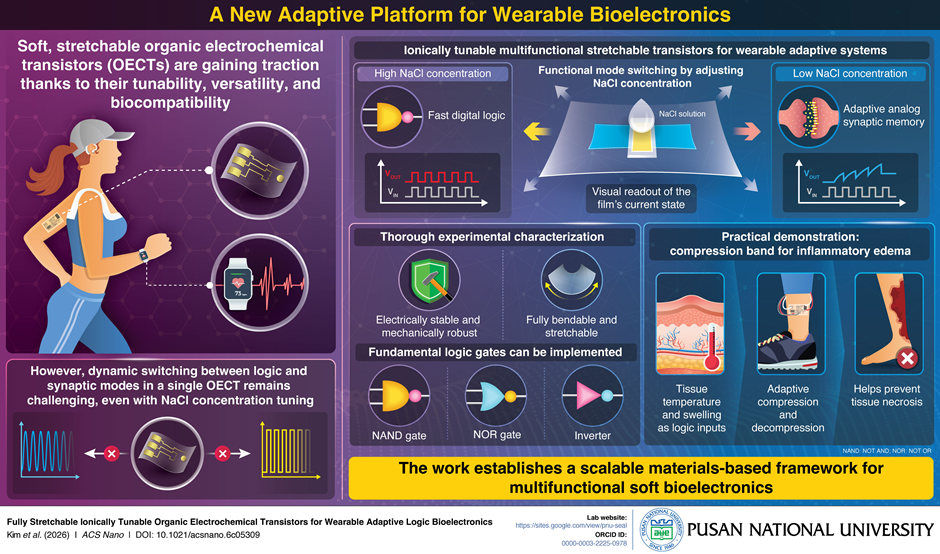
Image title: Innovative design of an adaptive soft multifunctional transistor for soft electronics
Image caption: The technology developed in this study could serve as the basis for a variety of medical and health-related wearable devices.
Image credit: Assistant Professor Hyunseok Shim from Pusan National University
License type: Original Content
Usage restrictions: Cannot be reused without permission
Wearable electronics are gradually evolving from simple sensors into featureful devices that can make basic decisions and support medical care in real time. To fully realize this vision, wearable systems must be soft and versatile to adapt naturally to the body while performing tasks, without sacrificing comfort or reliability. Creating such electronics that combine flexibility and computing in a single device remains a difficult challenge.
A pressing problem in this field is that most wearable electronic components available today are designed for one specific function. If engineers want a device that can sense signals, process information, and store data, they typically need to combine several different components into complex circuits. This increases the size and power consumption of the wearable system, making it costly and less suited for daily use. But what if a single soft electronic device could adaptively perform different functions?
In a recent study, a research team led by Assistant Professor Hyunseok Shim at Pusan National University, Korea, developed a stretchable organic electrochemical transistor (OECT) that can be easily reprogrammed to serve different purposes. This soft electronic device, which operates by moving ions through a conducting polymer, can be reversibly switched from a logic circuit for digital computations to an analog ‘artificial synapse’ by changing its surrounding salt concentration. This work was made available online in ACS Nano on June 24, 2026, and published in Volume 20, Issue 26 of the journal in July 2026.
Instead of creating an entirely new material, the researchers modified the conducting polymer PEDOT:PSS with two additives. These improved both the electrical conductivity of the OECT and its ability to repeatedly stretch without degrading. The key innovation, however, was that changing the concentration of sodium chloride in the electrolyte altered how ions moved through the transistor, making it possible to switch between operational modes. High salt concentrations enabled rapid ON/OFF gating, necessary for digital logic operations. On the other hand, lower salt concentrations produced an analog memory-like behavior, similar to the voltage profile of synapses between neurons.
Another distinctive feature is that the device’s internal state is visible; as it switches modes, it also changes color from light to dark blue, letting the user read out its operational status by just looking at it. “The proposed platform is suitable for smart electronic skin, wearable health monitors, and soft bioelectronic implants, where a single stretchable device can both process and store physiological signals without added circuitry,” says Dr. Shim. As a proof of concept, the team built a wearable patch that senses inflammatory edema and skin temperature, then automatically tightens or loosens a compression band, reducing the risk of tissue damage.
The team has high hopes for this platform, as Dr. Shim remarks: “In the longer term, this work could lead to autonomous personalized therapeutics, such as dynamic compression bandages and electronic skins that respond to injury in real time, all monitored at a glance through a visible color change.” By combining biological signaling with low-power computing performed directly within the sensor, the proposed technology could contribute to future neuromorphic bioelectronics, soft robots, and adaptive prosthetic devices that learn from and respond to their surroundings.
Reference
Title: Fully Stretchable Ionically Tunable Organic Electrochemical Transistors for Wearable Adaptive Logic Bioelectronics.
Journal Name: ACS Nano 2026 20 (26), 18883-18899.
DOI: 10.1021/acsnano.6c05309
About Assistant Professor Hyunseok Shim
Hyunseok Shim is an Assistant Professor in the School of Electronics and Electrical Engineering at Pusan National University, South Korea. His research focuses on the development of next-generation semiconductor devices, organic and stretchable electronics, and neuromorphic systems. He earned his Ph.D. in the Materials Science and Engineering Program at the University of Houston under the supervision of Professor Cunjiang Yu, a pioneer in stretchable and bio-integrated electronics, and subsequently completed postdoctoral training at The Pennsylvania State University. His work has been published in leading journals, including Nature Electronics, Science Advances, Nature Communications, PNAS, and Matter.
Website: https://sites.google.com/view/pnu-seal
ORCID id: 0000-0003-2225-0978
 PURCS_212_infographic_final.jpg
(1MB)
PURCS_212_infographic_final.jpg
(1MB)