

Researchers Develop a Hybrid Quantum Network with Indistinguishable Quantum Sources
Researchers have demonstrated successful two-photon interference between a warm atomic ensemble and quantum dots
Hybrid quantum sources are essential for developing large-scale quantum networks. However, heterogeneous single-photon sources have different spectral and temporal networks, necessitating modifications and synchronizations that lead to losses and the need for additional resources. In a new study, researchers have successfully achieved indistinguishable photon generation between two physically dissimilar quantum sources: warm atomic ensembles and quantum dots. The two sources also demonstrated high visibility two-photonic interference, marking a key step for future quantum networks.
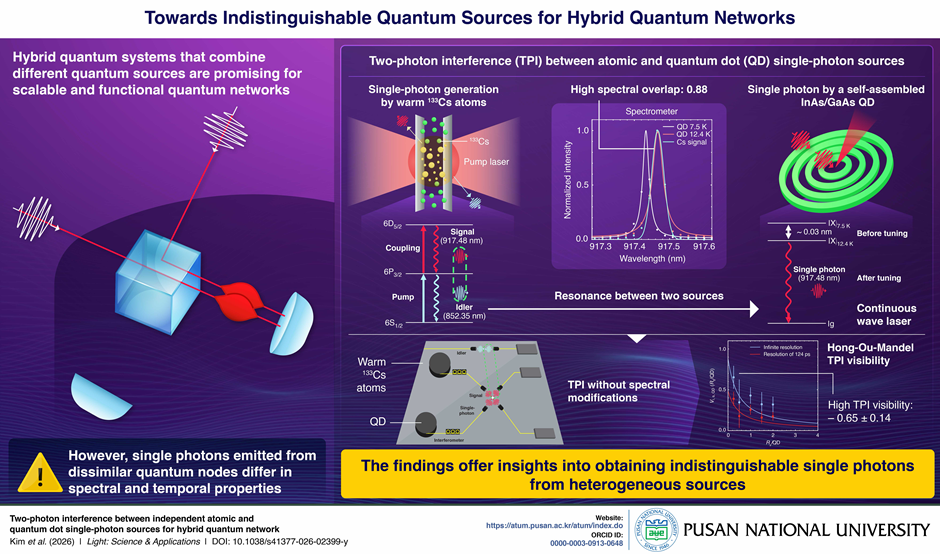
Image title: Proposed hybrid quantum network
Image caption: The two photon sources exhibit high spectral overlaps and demonstrate two photon interference with high visibility, representing an essential step for large-scale quantum networks
Image credit: Professor Han Seb Moon from Pusan National University, Korea
License type: Original Content
Usage restrictions: Cannot be reused without permission
Large-scale quantum communication networks require both reliable quantum memories and coherent single-photon sources that can exchange quantum information efficiently. A coherent source of single photons with narrow linewidth, high brightness, spectral uniformity, and compatibility with quantum memories is necessary. While a variety of single photon sources have been developed in recent years, such as quantum dots (QDs) and atoms in warm vapor cells, each has inherent limitations, making a scalable and functional quantum network challenging to achieve.
Hybrid quantum architectures that combine different quantum light sources can address these challenges. For example, QDs, which suffer from spectral randomness and are not well suited for photon storage, can be paired with atomic systems that provide reliable frequency standards and quantum memories. In such architectures, QDs can serve as bright, high-rate photon sources, while atomic systems handle photon storage and synchronization. However, a key challenge in realizing such hybrid quantum architectures is interfacing different quantum light sources. Single photons emitted from different sources exhibit distinct spatial and temporal properties, necessitating modifications and synchronizations that introduce losses and increase the need for resources.
In a breakthrough study, a research team led by Professor Han Seb Moon from the Department of Physics at Pusan National University and Professor Je-Hyung Kim from Ulsan National Institute of Science and Technology in the Republic of Korea has successfully achieved indistinguishable photon generation from two distinct quantum systems. “For the first time, we experimentally demonstrated direct two-photon interference between single photons from two completely independent, physically dissimilar quantum light sources: a warm cesium atomic ensemble and a semiconductor quantum dot (QD),” explains Prof. Moon. Their study was published in the journal Light: Science & Applications on July 15, 2026.
The researchers used warm cesium vapor cells and self-assembled indium arsenide/gallium arsenide (InAs/GaAs) QDs as independent single-photon sources. Using continuous-wave lasers to excite the cesium atoms, they generated heralded photon pairs, consisting of a signal photon at a well-defined wavelength of 917 nm and an idler photon at 852.35 nm.
To match the atomic photon wavelength, the researchers spectrally tuned the QDs by cooling them to 12.4 K, producing single-photon emission at 917.48 nm. This resulted in a high spectrum of 0.88 between the two sources, enabling high-visibility two-photon interference (TPI).
The team then experimentally demonstrated TPI, specifically the Hong–Ou–Mandel effect, between single photons emitted by the QD and heralded signal photons from the warm cesium ensemble under continuous excitation. Hong-Ou-Mandel TPI occurs when two indistinguishable photons enter a beam splitter through different input ports and are detected together in the same output mode. To quantify the TPI, the researchers measured its visibility, which is the relative contrast between the TPI of indistinguishable and distinguishable photons.
After correcting for the finite time resolution of the detection system, the researchers achieved a high interference visibility of 0.65 ± 0.14, providing direct evidence of indistinguishable single photon sources. Notably, this was achieved without needing any spectral or temporal modifications between the two sources.
“Our hybrid quantum network bridges the gap between photon generation and storage and provides a global frequency standard for remote quantum emitters,” remarks Prof. Moon. “In future, it can become the foundation for modular quantum networks spanning multiple institutions, paving the way for a working quantum internet. Such quantum communication networks could include distributed networks of atomic quantum sensors for navigation or sensing and practical building blocks for scalable quantum computers.”
Overall, this innovative hybrid quantum architecture represents an important step towards future quantum network architectures.
Reference
|
Title of original paper: |
Two-photon interference between independent atomic and quantum dot single-photon sources for hybrid quantum network |
|
Journal: |
Light: Science & Applications |
|
DOI: |
About the author
Dr. Han Seb Moon is a Professor in the Department of Physics at Pusan National University, Busan, Republic of Korea, and a member of the university's Quantum Sensors Research Center. His research focuses on atomic-ensemble-based quantum optics, including quantum light sources, quantum memory, quantum repeaters, entangled-photon generation, quantum interference, and atomic magnetic-field and Rydberg-atom electric-field sensors. He co-supervised this study with Prof. Je-Hyung Kim of UNIST, combining atomic and solid-state quantum photonic platforms toward hybrid quantum networks linking Busan and Ulsan.
Laboratory: https://atum.pusan.ac.kr/atum/index.do
ORCID Id: 0000-0003-0913-0648
 PURCS_202_Infographic_final.jpg
(1MB)
PURCS_202_Infographic_final.jpg
(1MB)