

ASTRA-Net for Improved Lung Airway Mapping
ASTRA-Net helps reconstruct overlooked peripheral airways, creating more complete maps for bronchoscopy procedures
Locating small lung tumors located deep within the lungs remains challenging, as they need to be navigated through a complex network of tiny airways. Existing AI systems trained on incomplete human annotations may also fail to identify peripheral airways that were omitted from the training labels. Researchers from Pusan National University developed a novel AI x-framework, ASTRA-Net, which helps recover previously overlooked peripheral airways—potentially enabling more accurate bronchoscopy maps for better lung cancer diagnosis.
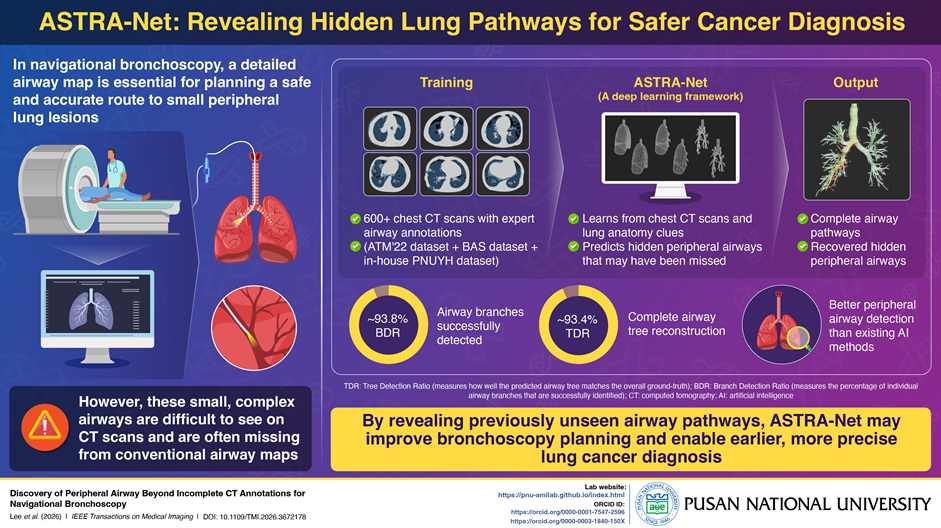
Image title: ASTRA-Net: Revealing Hidden Lung Pathways for Safer Cancer Diagnosis
Image caption: ASTRA-Net can identify previously overlooked lung airways from incompletely annotated CT scans, potentially helping doctors navigate to difficult-to-reach lung lesions.
Image credit: Professor MinWoo Kim from Pusan National University, Korea
License type: Original Content
Usage restrictions: Cannot be reused without permission
Lung cancer is the most diagnosed cancer globally and is one of the leading causes of cancer-related deaths. Early detection of the same can prove to be a boon for survival. However, collecting tissue samples from small tumors located deep within the lungs remains a big challenge. As many of these lesions are found in the peripheral regions of the lungs, physicians must navigate through an intricate network of tiny branching airways to reach the target.
In these cases, clinicians rely on lung navigation systems that use three-dimensional airway maps reconstructed from computed tomography (CT) scans to guide instruments toward suspicious lesions. Eventually, the accuracy of these navigation systems depends heavily on the completeness of the airway maps to guide them. Creating these maps is again difficult, as the smallest peripheral airways are extremely thin and difficult to distinguish from the surrounding tissues. This restriction raises a concern that if artificial intelligence (AI) systems are trained using incomplete information, they may also overlook clinically important airways.
To address this challenge, researchers from Pusan National University in South Korea developed ASTRA-Net (Anatomical Segmentation with Tree-aware Refinement Attention), an AI x-framework designed to identify previously overlooked airway branches and generate more complete airway maps. The study was led by Dr. MinWoo Kim from the School of Biomedical Convergence Engineering, Pusan National University, and Dr. Hee Yun Seol from the Division of Pulmonary and Critical Care Medicine, Research Institute for Convergence of Biomedical Science and Technology, Pusan National University Yangsan Hospital, in collaboration with other researchers. This paper was made available online on March 9, 2026, and was published in Volume 45, Issue 6 of the journal IEEE Transactions on Medical Imaging on June 01, 2026.
Unlike conventional models that may be limited by incomplete training annotations, ASTRA-Net was designed to identify anatomically plausible airway structures that may have been omitted from the original labels.
“ASTRANET is not simply another airway segmentation model. It was specifically designed to identify peripheral airways that may have been overlooked during manual annotation, thereby helping to create a more complete roadmap for bronchoscopy,” explains Dr. Kim.
ASTRA-Net utilizes a multi-stage deep learning architecture like those employed in advanced medical image analysis. A part of this network learns the overall structure of the lungs, whereas another refines regions where airway boundaries are unclear. An additional attention mechanism helps the model focus on regions where small peripheral airways are difficult to distinguish or may have been omitted from the annotations. This allows the reconstruction of airway branches that are often missing from CT annotations. By incorporating anatomical clues from the surrounding lung tissues and blood vessels, which often run alongside the airways, the system can infer the continuity of previously unrecognized airway pathways.
Researchers also evaluated the x-framework using multiple datasets as well as clinical CT scans obtained from Pusan National University Yangsan Hospital. This model demonstrated strong performance in identifying fine peripheral airways and remained robust even when CT scans varied in image quality and slice thickness. Additionally, expert review of the model predictions showed that some structures initially counted as false positives were genuine airway branches that had been omitted from the original annotations.
"By providing physicians with a more complete airway roadmap, we hope this technology will improve navigation to difficult-to-reach lung lesions and support the development of future AI-assisted and robotic bronchoscopy systems," concludes Dr. Kim.
Reference
|
Title of original paper: |
Discovery of Peripheral Airway Beyond Incomplete CT Annotations for Navigational Bronchoscopy |
|
Journal: |
IEEE Transactions on Medical Imaging |
|
DOI: |
About Dr. MinWoo Kim
Dr. MinWoo Kim is affiliated with the School of Biomedical Convergence Engineering and the Center for Artificial Intelligence Research at Pusan National University, Republic of Korea, where he leads research in medical artificial intelligence and advanced image analysis. His research focuses on integrating artificial intelligence, biomedical engineering, and medical imaging technologies to support image-guided diagnosis and intervention. Currently, he is working on integrating clinical pulmonary medicine and artificial intelligence for advanced medical imaging and image-guided diagnosis.
Lab website address: https://pnu-amilab.github.io/index.html
ORCID id: https://orcid.org/0000-0001-7547-2596
About Dr. Hee Yun Seol
Dr. Hee Yun Seol is an Assistant Professor of Medicine at the Department of Internal Medicine at Pusan National University School of Medicine and the Division of Pulmonary and Critical Care Medicine at Pusan National University Yangsan Hospital, Republic of Korea. He specializes in pulmonary medicine, bronchoscopy, lung cancer, and interventional pulmonology, with a particular interest in translating emerging technologies into clinical practice.
ORCID id: https://orcid.org/0000-0003-1840-150X
 PURCS_197_Infographics_final.png
(1MB)
PURCS_197_Infographics_final.png
(1MB)