

Researchers Show How Korea’s Emission Trading Reforms Would Impact Its Power Sector
Researchers show changes to benchmarking method, auctioning ratio, and carbon pricing impact different types of power generation companies differently
The effects of proposed reforms to Phase IV of the Korean Emissions Trading Scheme on Korea’s electricity market remain poorly understood. In a new study, researchers developed and applied an integrated modeling x-x-framework to simulate the effects. They found that changing benchmarking mechanisms alone is insufficient to drive decarbonization. It should also be combined with expanded auctioning, higher carbon pricing, and complementary support systems to make a large-scale economic and environmental impact.
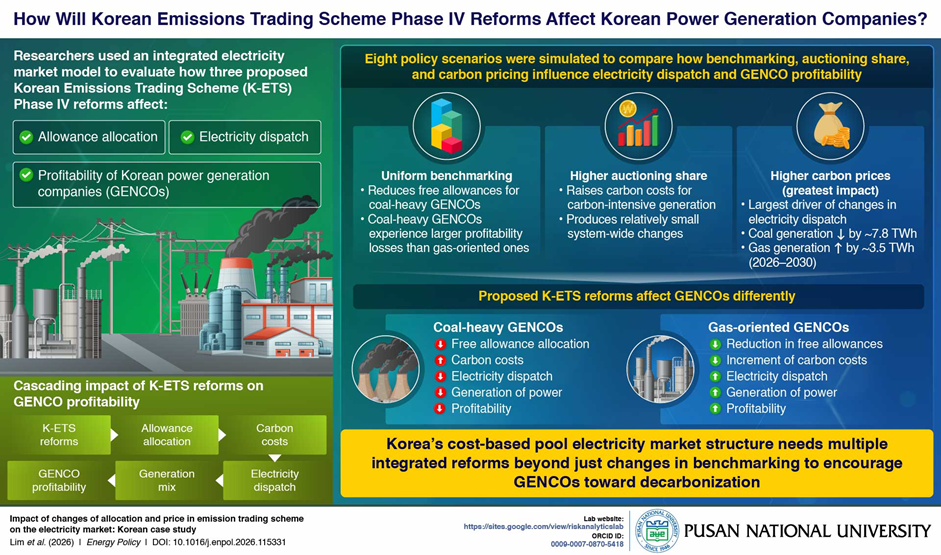
Image title: The Impact of Proposed Reforms to the Korean Emissions Trading Scheme on the Electricity Market
Image caption: A simulation study revealed that for Korea’s electricity market, an integrated policy approach combining a uniform benchmark, a higher auctioning ratio, higher carbon pricing, and complementary supportive measures is critical to achieving decarbonization without placing an excessive burden on power generation companies.
Image credit: Assistant Professor Dowon Kim from Pusan National University, Korea
License type: Original Content
Usage restrictions: Cannot be reused without permission
South Korea has ambitious climate goals, with a strong focus on reducing greenhouse gas emissions from its electricity sector. To this end, Korea launched the Korean Emissions Trading Scheme (K-ETS) in 2015: a policy that sets limits on companies’ emissions and allows them to trade emission permits or allowances. However, the K-ETS has faced structural challenges, prompting the government to propose reforms in the fourth implementation phase (2026-2030). Importantly, the K-ETS and the proposed reforms are largely based on the European Union Emissions Trading System (EU-ETS). So, whether the reforms will deliver EU-like outcomes in Korea’s electricity sector is uncertain, as market conditions in the EU and Korea are vastly different.
To explore further, a research team from South Korea, led by Assistant Professor Dowon Kim from Pusan National University, analyzed how the proposed K-ETS reforms would affect the electricity market, specifically the power generation sector. Prof. Kim emphasizes, “The power sector is expected to contribute nearly 44.3% of Korea's total national emissions reduction target, making it critical to understand the interaction between K-ETS reforms and electricity market operation.” Their study was made available online on April 24, 2026, and published in Volume 215 of Energy Policy in August 1, 2026.
Researchers first developed a computational model of the Korean electricity market. They then applied it to multiple scenarios containing different combinations of three policy variables: first, a fuel-specific versus a uniform benchmark (the standard for receiving free emission allowances varies for power plants depending on their energy source, whereas the proposed reform suggests a single standard for all plants); second, the current versus the proposed increase in auctioning share (or percentage of allowances that companies must buy through auctions); and third, the current versus the proposed increase in carbon pricing (or cost charged for producing emissions).
The strongest impact came from increasing carbon pricing, which raised both electricity generation and emissions costs more for coal than for gas, leading companies to partially shift from coal to gas.
In conclusion, Prof. Kim emphasizes, “The proposed K-ETS reforms should be implemented along with complementary measures, like targeted investment and transitional support, to maximize their impact, mostly because Korea’s electricity market is highly centralized and limits companies' ability to recover rising costs by charging consumers more.” Integrated policies are thus necessary to drive electricity decarbonization while protecting the stability of the power sector.
Reference
|
Title of original paper: |
Physics-informed multi-x-x-objective optimization for fuel consumption and air-pollutant exposure in ship operations |
|
Journal: |
Energy Policy. |
|
DOI: |
About Professor Dowon Kim
Dr. Dowon Kim is an Assistant Professor in the Department of Industrial Engineering at Pusan National University. He also serves as Vice Director of the Safe & Clean Supply Chain (SCSC) Research Center and leads the Risk Analytics Lab. His research lies at the intersection of stochastic modeling, mathematical optimization, and machine learning, with applications in energy systems and maritime logistics. Through his work, he is dedicated to solving complex, real-world industrial problems and driving practical artificial intelligence (AI) transformation for enterprises.
Website: https://sites.google.com/view/riskanalyticslab
ORCID id: 0009-0007-0870-5418
 PURCS_205_Infographic_final.jpg
(370KB)
PURCS_205_Infographic_final.jpg
(370KB)