

Uncovering How Chronic Environmental Stress Drives Immune Dysfunction in Cold Tumors
New study reveals how chronic environmental stress reprograms natural killer cells, enabling immune escape in cold tumors
Immunotherapy has transformed cancer care, yet many "cold tumors," including ovarian, breast, and prostate cancers, remain resistant because they evade immune recognition. While chronic environmental stress is known to influence immunity, exactly how it undermines the body's natural cancer-fighting defenses has remained unclear. A new study from Korea uncovers how long-term environmental stress drives immune dysfunction, helping explain why cold tumors continue to evade even advanced immunotherapies.
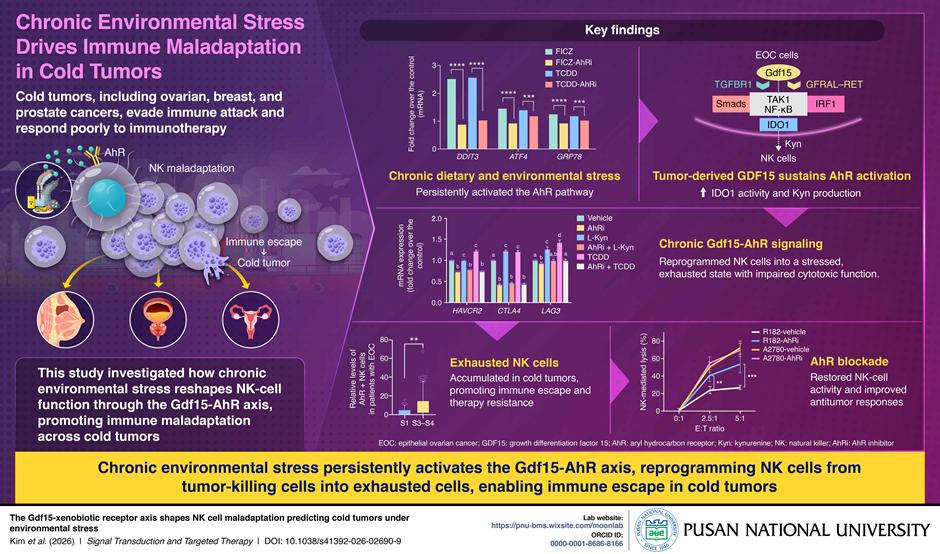
Image title: Chronic Environmental Stress Drives Immune Maladaptation in Cold Tumors
Image caption: Long-term environmental and metabolic stress sustain activation of the GDF15–IDO1–kynurenine–AhR pathway, reprogramming natural killer cells into a maladaptive exhausted state that promotes immune escape in cold tumors.
Image credit: The authors
License type: Original Content
Usage restrictions: Cannot be reused without permission
Immunotherapy has transformed cancer treatment, yet many tumors remain stubbornly resistant to its effects. Among the most challenging are "cold tumors," including ovarian, breast, and prostate cancers, which evade immune attack and respond poorly to existing immunotherapies. Although chronic environmental and metabolic stress is known to impair immune function, how long-term environmental and dietary stress reprograms natural killer (NK) cells—the body's frontline defenders against cancer—has remained poorly understood.
To address this challenge, researchers led by Professor Yuseok Moon at Pusan National University investigated how chronic environmental stress drives NK-cell maladaptation in cold tumors. Using epithelial ovarian cancer as a representative model of an immunologically "cold" tumor, the team examined how persistent activation of the Aryl Hydrocarbon Receptor (AhR), a cellular sensor that responds to environmental chemicals, dietary compounds, and endogenous metabolites, reshapes NK-cell function. Their findings were published in Signal Transduction and Targeted Therapy on June 5, 2026.
To uncover this mechanism, the researchers combined bulk transcriptomic analyses, single-cell RNA sequencing, clinical patient cohort analyses, NK-cell functional assays, mouse tumor models, and clinical patient samples. They also investigated the roles of Growth Differentiation Factor 15 (GDF15), indoleamine 2,3-dioxygenase 1 (IDO1), kynurenine, and AhR signaling in regulating NK-cell activity.
The study revealed that chronic environmental and metabolic stress sustains activation of the GDF15–IDO1–kynurenine–AhR signaling axis, gradually reprogramming NK cells from an active tumor-killing state into an exhausted, maladaptive state. While transient AhR activation supports NK-cell maturation and antitumor activity, persistent activation under chronic stress impairs immune surveillance. Using epithelial ovarian cancer as a representative model, the team showed that chemoresistant tumor cells produce high levels of GDF15, driving sustained AhR activation through increased IDO1 activity and kynurenine production. As NK cells become exhausted, their cancer-killing ability declines, enabling immune escape and reducing responsiveness to immunotherapy. Blocking AhR signaling restored NK-cell function, highlighting the GDF15–AhR axis as a promising therapeutic target.
"We found that a cancer-secreted factor, GDF15, activates a stress-sensing receptor (AhR) in natural killer (NK) cells—the body's frontline defense against cancer," explains Prof. Moon. "While this initially helps NK cells attack tumor cells, persistent activation by tumor-derived metabolites together with environmental chemical stressors, such as endocrine-disrupting compounds, gradually exhausts these cells, causing them to accumulate within tumors, compromising their anticancer actions despite their sustained retention within tumors."
The findings also have important clinical implications. Prof. Moon notes, "Measuring circulating GDF15 levels together with AhR activity in NK cells could help identify patients who are less likely to respond to immunotherapy, enabling earlier and more personalized treatment decisions." He further adds, "Targeting the GDF15–AhR axis, particularly through AhR inhibitors, may restore NK-cell function and help convert immune-cold tumors into immunotherapy-responsive tumors when combined with existing immune checkpoint inhibitors." The findings also suggest that long-term exposure to environmental AhR-activating chemicals may contribute to immune dysfunction, reinforcing the importance of environmental factors in shaping cancer immunity.
Overall, the study identifies the GDF15–AhR axis as a key driver of NK-cell maladaptation in cold tumors. The findings provide a foundation for therapies that restore NK-cell function and improve the response of immune-resistant cold tumors to immunotherapy.
Reference
|
Title of original paper: |
The Gdf15-xenobiotic receptor axis shapes NK cell maladaptation predicting cold tumors under environmental stress |
|
Journal: |
Signal Transduction and Targeted Therapy |
|
DOI: |
About Prof. Yuseok Moon
Dr. Yuseok Moon is a Professor at the Pusan National University School of Data Science and College of Medicine, and a Fellow of the Academy of Toxicological Sciences (ATS). His laboratory investigates how environmental and xenobiotic stressors in the food system shape disease outcome pathways, integrating receptor-based toxicology, immunology, and omics approaches in cross-species models. Prof. Moon's group has long studied stress-responsive signaling in chronic human diseases including cancers. He also develops translational x-frameworks bridging toxicology, environmental health, and economic/policy analysis.
Lab: https://pnu-bms.wixsite.com/moonlab
ORCID id: 0000-0001-8686-8166
About Prof. Ki-Hyung Kim
Dr. Ki-Hyung Kim is a Professor in the Department of Obstetrics and Gynecology at Pusan National University School of Medicine and Pusan National University Hospital. Dr. Kim's collaborative work bridges clinical oncology practice with translational and molecular research, contributing patient-derived clinical insights and specimens that link laboratory findings on tumor immunity to real-world disease progression and treatment outcomes in epithelial ovarian cancer patients.
 PURCS_208_Infographics_final.jpg
(1MB)
PURCS_208_Infographics_final.jpg
(1MB)