

Pusan National University Develops Smart Nanoparticles That Deliver Antibiotics Directly to H. pylori
A bioinspired nanoparticle delivery system targets bacteria hidden beneath the stomach's mucus layer
Helicobacter pylori hide deep beneath the stomach's protective mucus layer, making gastric ulcers difficult to treat with conventional antibiotics. To address this challenge, researchers developed a multifunctional nanoparticle engineered to overcome the stomach's biological barriers and deliver antibiotics directly to the infection site. The study evaluates the precise, localized drug delivery approach for improving the treatment of H. pylori-associated gastric ulcers.
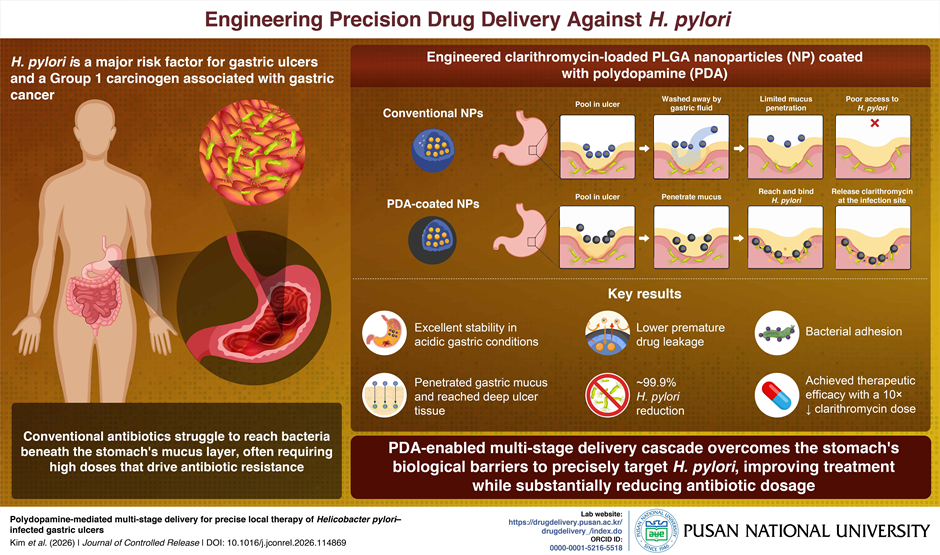
Image title: Researchers Advances Targeted Therapy for H. pylori-Infected Gastric Ulcers
Image caption: Polydopamine-coated nanoparticle platform overcomes gastric acid, mucus, and deep tissue barriers to deliver antibiotics directly to H. pylori -infected gastric ulcers
Image credit: The authors
License type: Original Content
Usage restrictions: Cannot be reused without permission
Helicobacter pylori bacteria infect around half the global population and are a leading cause of stomach ulcers and gastric cancer. While antibiotics remain the standard treatment, they often fail to reach bacteria hidden beneath the stomach's protective mucus layer and deep within ulcer tissue. This often requires higher antibiotic doses, increasing the risk of adverse effects and antibiotic resistance. These limitations highlight the need for targeted drug delivery systems that deliver antibiotics directly to the infection site while overcoming the stomach's biological barriers.
To address this challenge, researchers from Pusan National University developed polydopamine-functionalized, clarithromycin-loaded PLGA nanoparticles designed to execute a multi-stage delivery cascade. Explaining the motivation behind the study, lead author, Dr. Jin-Wook Yoo says, "We developed a targeted nanoparticle platform that delivers antibiotics directly to H. pylori hidden deep within gastric ulcers. By overcoming the gastric mucus barrier and precisely targeting the infection site, this approach enables precise local therapy." This paper was made available online on March 30, 2026, and was published in Volume 394 of the Journal of Controlled Release on June 10, 2026.
The nanoparticles were fabricated using a nanoprecipitation method followed by polydopamine surface coating. Their physicochemical properties, including size, morphology, surface chemistry, stability, drug loading, and release profile, were thoroughly characterized. The platform was then evaluated through in vitro, ex vivo, and in vivo studies that assessed mucus penetration, bacterial adhesion, gastric retention, tissue penetration, antibacterial activity, and therapeutic efficacy in a mouse model of H. pylori-infected gastric ulcers.
The engineered nanoparticles successfully completed each stage of the delivery cascade. They remained stable under acidic gastric conditions, minimized premature clarithromycin release, penetrated the gastric mucus barrier, selectively accumulated at ulcer sites, and reached approximately 400 μm into ulcer tissue where deep-seated H. pylori reside. The polydopamine coating also enabled strong, ligand-independent bacterial adhesion, allowing localized antibiotic release directly at the infection site. This precision targeting achieved approximately 99.9% bacterial reduction, accelerated ulcer healing, prolonged gastric retention, and promoted tissue regeneration. Notably, these therapeutic benefits were achieved using a 10-fold lower dose of clarithromycin than conventional systemic therapy.
The findings demonstrate how multifunctional nanomedicine can overcome the biological barriers that limit conventional antibiotic treatment. Dr. Yoo says, “Our targeted drug delivery strategy could simplify treatment by reducing the required antibiotic dose while maintaining therapeutic efficacy. This may improve patient compliance, decrease treatment failure, and reduce the emergence of antibiotic-resistant H. pylori.” He further adds, “Beyond gastric ulcers, we also believe that this precise local delivery platform could be adapted to treat other diseases where biological barriers limit the effectiveness of conventional therapies, expanding its impact well beyond H. pylori infection.”
Overall, the study establishes PDA-functionalized nanoparticles as a promising platform for precision local antibiotic therapy. By overcoming the stomach's natural defenses and targeting deep-seated bacteria, this approach could enable safer, more effective treatments with lower antibiotic doses and broader therapeutic potential.
Reference
Title of original paper: Polydopamine-mediated multi-stage delivery for precise local therapy of
Helicobacter pylori–infected gastric ulcers
Journal: Journal of Controlled Release
DOI: 10.1016/j.jconrel.2026.114869
About the author
Dr. Jin-Wook Yoo is a professor at the College of Pharmacy in Pusan National University, Republic of Korea, and has over 20 years of experience in drug delivery systems. His research focuses on localized therapies and integrating advanced nanotechnology into developing innovative solutions for cancer treatment and wound healing. He has pioneered cutting-edge localized therapies via oral administration, utilizing systems that respond to the gastrointestinal environment, and developed biocompatible nitric oxide-releasing materials. Prof. Yoo’s work demonstrates efficacy in preclinical cancer and wound models, advancing precision and safety in therapeutic applications to improve patient outcomes.
Lab website: https://drugdelivery.pusan.ac.kr/drugdelivery_/index.do
ORCID: 0000-0001-5216-5518
 PURCS_192_Infographic_final.jpg
(1MB)
PURCS_192_Infographic_final.jpg
(1MB)