

Study Reveals How Communication Sequence Strengthens Green Persuasion
New research says the sequence of sustainable communication matters— negative-to-positive, rather than isolated positive appeals
A Pusan National University study reveals that sustainability communication may depend not only on the message itself but also on the sequence in which the environmental information is presented. The study reveals that an initial exposure to environmental degradation can heighten early attentional engagement and emotional arousal, while a subsequent positive green solution creates a contrast-based shift in emotional valence that drives stronger pro-environmental behaviors.
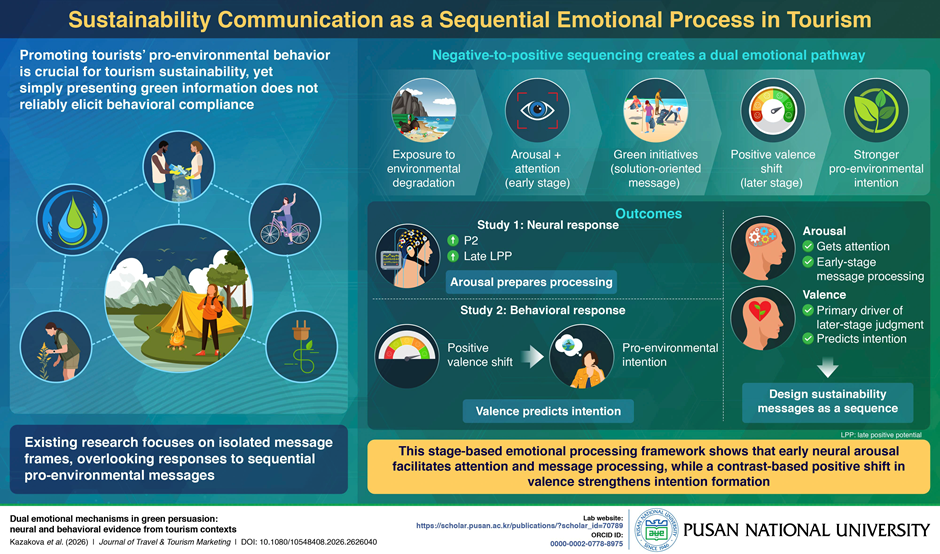
Image title: Sustainability Communication as a Sequential Emotional Process in Tourism
Image caption: The study reveals that the sequence of sustainability communication matters, with negative-to-positive message sequencing producing stronger persuasive effects than isolated positive appeals
Image credit: Professor Insin Kim from Pusan National University, Korea
License type: Original Content
Usage restrictions: Cannot be reused without permission
The impact of sustainability messages may depend not only on their content but also on the order in which they are presented. The emotional response created by one message may influence how people interpret the message that follows when it comes to green initiatives. In tourism, where visitors are frequently encouraged to make environmentally responsible choices, understanding how these emotional responses unfold could help organizations design more effective sustainability communication.
Environmental communication often presents the problem and the solution as separate messages. However, people may perceive environmental messages as a sequence, first learning about environmental harm, then encountering possible solutions. This raises the possibility that an initial negative emotion could influence how a subsequent positive message is perceived.
To investigate this process, Professor Insin Kim and Dr. Alisa Kazakova of Pusan National University collaborated with Dr. Marcel Bastiaansen of Breda University of Applied Sciences and Tilburg University in the Netherlands to examine how emotional responses unfold across successive stages of green persuasion. The researchers developed a stage-based emotional processing x-framework that clarifies the distinct roles of arousal and valence in sustainability message processing. This paper was made available online in Volume 43, Issue 4 of the Journal of Travel & Tourism Marketing on June 13, 2026.
The researchers tested their x-framework across two complementary studies combining neural and behavioral evidence, focusing on arousal and valence as two distinct emotional attributes. In Study 1, a 64-channel electroencephalography experiment demonstrated that prior exposure to tourism-related environmental degradation heightened early attentional allocation and sustained neural engagement with subsequently presented green solutions. In Study 2, the same negative-to-positive message sequence produced a contrast-based positive shift in emotional valence, which in turn increased pro-environmental behavioral intention.
The findings revealed that emotional arousal and valence play distinct roles during the persuasion process. Arousal seemed to facilitate early-stage attention and message processing; however, it did not directly influence participants’ intention to engage in pro-environmental behavior. On the other hand, valence-based evaluation emerged as the primary factor associated with later judgment and behavioral intention.
Prof. Kim explains, “Our findings clarify the distinct functional roles of arousal and valence across successive stages of persuasion: early emotional activation facilitates attention and message processing, whereas subsequent valence-based evaluation drives later judgment and intention formation.”
The findings of this study could have practical implications for tourism organizations that rely on visitor participation to support environmental activities. Airlines, cruise operators, and nature-based destinations could structure sustainability communication as an emotional sequence rather than presenting green initiatives as isolated messages. For instance, the strategy could first draw attention to an environmental concern followed by a credible and achievable solution, such as choosing lower-carbon travel options, supporting marine conservation, or contributing to tourist destination protection.
The researchers suggest that a carefully designed progression from environmental concern to a positive and feasible solution can help translate heightened attention into constructive engagement. However, environmental information should be authentic and proportionate, rather than designed simply to frighten or overwhelm visitors. Connecting emotionally salient environmental information with a credible and actionable solution could help organizations encourage greater participation in pro-environmental initiatives.
Over the next few years, this strategy could influence how sustainability messages are delivered across digital booking platforms, destination applications, smart signage, and immersive tourism experiences. Rather than relying on a single environmental appeal, organizations could coordinate messages across different stages of the visitor journey.
This study demonstrates that effective persuasion depends not simply on eliciting emotional arousal but on guiding early attention toward a positive evaluation of credible solutions. This principle may also inform climate, conservation, public health, and other social-impact communication beyond tourism. Prof. Kim concludes, “Future campaigns should be designed not simply to evoke intense reactions, but to guide early attention toward a positive evaluation of credible solutions and, ultimately, a willingness to act responsibly.”
Reference
|
Title of original paper: |
Dual emotional mechanisms in green persuasion: neural and behavioral evidence from tourism contexts |
|
Journal: |
Journal of Travel & Tourism Marketing |
|
DOI: |
About Professor Insin Kim
Insin Kim is a professor in the Department of Tourism and Convention at Pusan National University. Her research team develops interdisciplinary, consumer-centered models for designing and integrating emerging technologies in hospitality and tourism. The team’s research advances human-robot collaboration in the hospitality industry, develops technology-adoption models for drone food delivery services and 3D-printed food restaurants, and optimizes human-technology service configurations across airport journeys. The team also integrates neuroscience with behavioral experiments in tourism marketing and adapts survival analysis from medicine and engineering to identify determinants of regional event survival. Her work connects technological innovation with sustainable, human-centered, and resilient tourism systems.
Lab: https://scholar.pusan.ac.kr/publications/?scholar_id=70789
ORCID id: 0000-0002-0778-8975
 PURCS_216_Infographic_final.jpg
(2MB)
PURCS_216_Infographic_final.jpg
(2MB)