

Study Reveals Why Mg Alloy Ballistic Performance Depends on Impact Direction
New study reveals how crystallographic texture and impact direction shape the ballistic response of lightweight AZ31 magnesium alloys
New research from Pusan National University, South Korea, shows that the direction in which a lightweight AZ31 magnesium alloy plate is struck can strongly affect its ballistic performance. Using high-velocity impact tests, microscopy, crystallographic analysis, and finite-element simulations, researchers traced how crystal texture influences deformation, stress localization, and fracture. The findings could help inform the design of lighter protective structures for weight-sensitive applications.
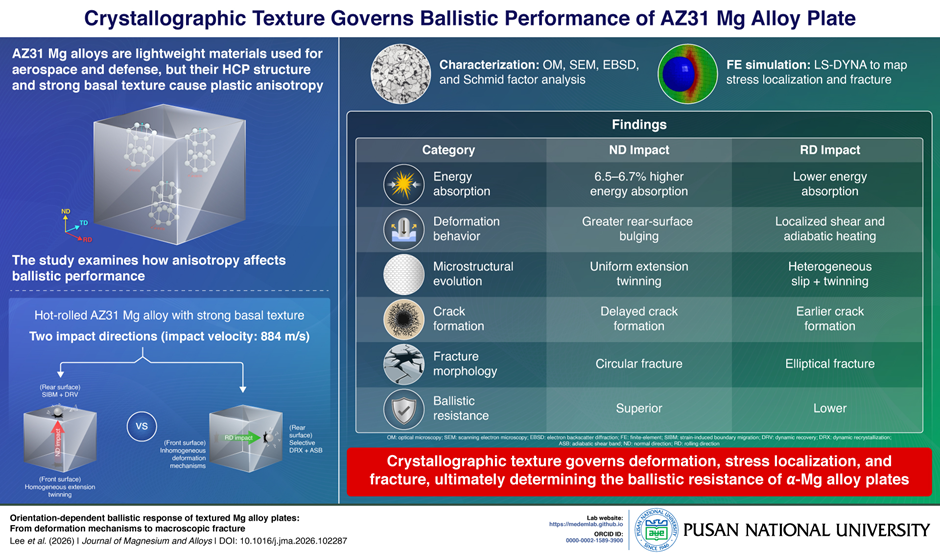
Image title: Texture-Driven Ballistic Response of AZ31 Mg Alloy
Image caption: ND impacts absorb more energy and promote bulging, while RD impacts concentrate shear and produce asymmetric fracture.
Image credit: The authors
License type: Original Content
Usage restrictions: Cannot be reused without permission
While anisotropy in the quasi-static mechanical behavior of Mg alloys has been extensively studied, how this anisotropy governs deformation and fracture during high-velocity ballistic impact remains poorly understood. To address this gap, researchers from Pusan National University, led by Professor Taekyung Lee, in collaboration with Seoul National University and Kyungpook National University, investigated how impact direction and crystallographic texture influence the ballistic performance and fracture behavior of AZ31 Mg alloy. The study was made available online on September 26, 2026, and will be published in Volume 24 of the Journal of Magnesium and Alloys on November 01, 2026.
Researchers tested hot-rolled AZ31 Mg alloy plates with a strong basal texture under high-velocity impacts along the normal direction (ND) and rolling direction (RD) at ~884 m/s, using plates 5–20 mm thick. Projectile velocity, energy absorption, penetration behavior, bulging, and fracture morphology were evaluated. Microstructural characterization and crystallographic analysis revealed the position- and direction-dependent deformation mechanisms. Finite-element simulations complemented these observations by mapping stress localization, plastic dissipation, and damage accumulation, thereby explaining the localized conditions associated with shear-band formation and fracture.
The findings revealed a striking direction-dependent difference in ballistic performance. Prof. Lee explains, “Plates impacted along the ND consistently absorbed 6.5–6.7% more energy and fractured in a symmetric manner upon perforation. In thicker plates that resisted full perforation, ND impact promoted bulging rather than cracking. By contrast, impact along the RD produced localized shear bands and asymmetric, elliptical fractures.” The contrasting responses arose from distinct deformation mechanisms: ND impacts promoted uniform extension twinning and homogeneous stress distribution, while RD impacts triggered heterogeneous slip and twinning, shear localization, adiabatic heating, and dynamic recrystallization. These findings demonstrate that crystallographic texture strongly governs the deformation, energy absorption, and fracture of α-Mg alloys under high-velocity impact.
The study points to an economical pathway for improving ballistic protection without adding material weight. Prof. Lee noted, “Instead of inventing a new alloy or adding weight, engineers can boost ballistic resistance simply by orienting the plate so that impacts arrive along the direction in which its texture promotes uniform, symmetric deformation. This is essentially "free" performance extracted from material that already exists.” Such orientation-aware design could support lighter, more impact-resistant Mg alloy components for military vehicle panels, protective structures, and other weight-sensitive applications.
Overall, the study identifies crystallographic texture and component orientation as important design variables for the ballistic performance of textured Mg alloys. By linking crystal-scale deformation with stress localization and macroscopic fracture, the findings provide a basis for exploring texture-engineered lightweight protective structures. Further research will be needed to determine how the approach performs under more complex, real-world impact conditions.
|
Title of original paper: |
Orientation-dependent ballistic response of textured Mg alloy plates: From deformation mechanisms to macroscopic fracture |
|
Journal: |
Journal of Magnesium and Alloys |
|
DOI: |
About the author
Dr. Taekyung Lee is a Professor in the School of Mechanical Engineering at Pusan National University, Korea. His group specializes in the physical metallurgy of lightweight structural alloys, with particular focus on Mg and Ti alloys, microstructure–property relationships, deformation mechanisms, and machine-learning-assisted interpretation of mechanical behavior. His research aims to bridge atomic-scale deformation physics and macroscopic structural performance to enable next-generation lightweight materials for the transportation, aerospace, and defense industries.
Lab: https://medemlab.github.io
ORCID ID: 0000-0002-1589-3900
 PURCS_214_Infographic_final.jpg
(1MB)
PURCS_214_Infographic_final.jpg
(1MB)