

Two-photon interference between independent atomic and quantum dot single-photon sources for hybrid quantum network
Pusan National University and UNIST Achieve World's First Direct Quantum Interference Between Dissimilar Quantum Light Sources
A joint research team led by Professor Han Seb Moon (Department of Physics, Pusan National University) and Professor Je-Hyung Kim (UNIST) has, for the first time in the world, demonstrated direct quantum interference between single photons generated independently from two fundamentally different quantum platforms: a warm cesium atomic ensemble and a semiconductor quantum dot (InAs/GaAs). This proves that light from an atom and light from a solid-state emitter can be used interchangeably as a single, unified quantum resource.
Quantum networks require photons from different quantum nodes -atoms, quantum dots, color centers, etc.- to be indistinguishable from one another. Because each platform naturally emits photons with different wavelengths, linewidths, and timing, prior approaches relied on lossy spectral filters and complex pulse-synchronization schemes to force a match. This is the key bottleneck that has limited practical hybrid quantum networks.
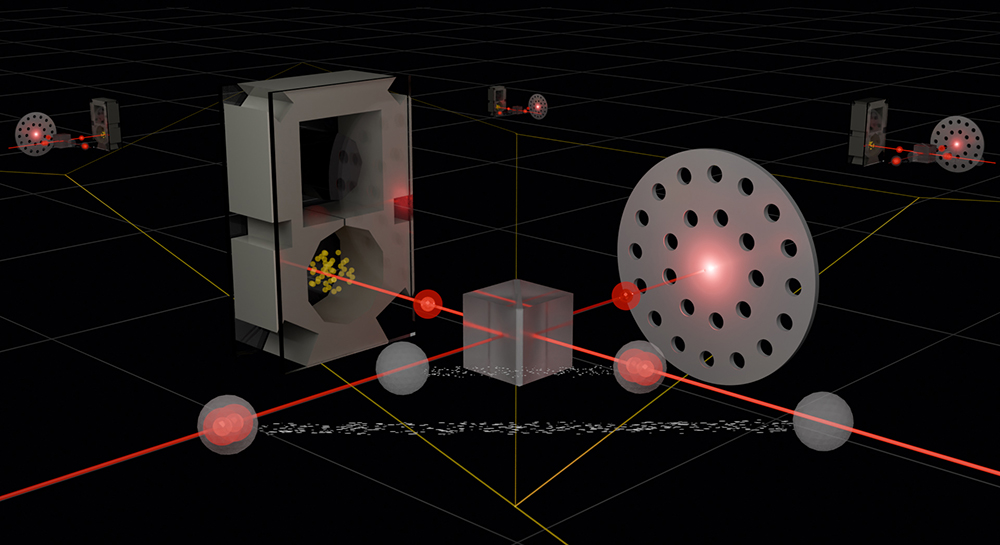
The cesium atomic ensemble generates heralded single photons at 917.48 nm via spontaneous four-wave mixing, while the quantum dot's emission was temperature-tuned to match this same wavelength. Critically, the team matched not just the wavelength but also the spectral linewidth of both sources, achieving high spectral overlap without any lossy spectral-correction optics. Using continuous-wave operation and time-resolved coincidence detection, they observed a clear Hong-Ou-Mandel (HOM) interference signal between the atomic and quantum-dot photons -the hallmark of photon indistinguishability- marking the first such demonstration between these two dissimilar platforms.
The result shows that quantum dots (bright, fast photon generation) and atomic ensembles (stable frequency reference, compatibility with quantum memory) can play complementary roles within a single hybrid quantum node. The atomic system's absolute frequency reference could help synchronize photons across distant, geographically separated quantum nodes -a foundation for scalable, multi-site hybrid quantum networks.
- Authors (Pusan National University)
· First author: Heewoo Kim (Department of Physics)
· Corresponding author: Han Seb Moon (Department of Physics)
- Title of original paper: Two-photon interference between independent atomic and quantum dot single-photon sources for hybrid quantum network
- Journal: Light: Science & Applications
- Web link: https://www.nature.com/articles/s41377-026-02399-y
- Contact e-mail: hsmoon@pusan.ac.kr
 202611문한섭교수1.jpg
(420KB)