

PNU 리서치
- 메인으로 이동
- 연구/산학
- PNU 리서치
부산대 연구실에서 개발된 ‘빛으로 봉합하는’ 의료용 신소재가 기술이전을 거쳐, 실제 수술 현장에 쓰일 ‘경막 봉합용 듀라 실란트’로 탄생해 상용화 단계에 성큼 다가섰다.
부산대기술지주 제17호 자회사인 ㈜에스엔비아에 2024년 이전된 교내 우수 연구성과인 ‘의료용 광가교 소재(HAMA-PA)’ 기술이 의료기기인 ‘경막봉합용 광경화(Photocurable) 듀라 실란트(Dura Sealant)’ 개발로 이어져 비임상 완료 단계에 진입했으며, 연내 상용화를 위한 의료기기 임상시험 신청까지 진행할 예정이다.
이 기술은 바이오소재과학과 양승윤 교수가 개발한 것으로, 기존 조직봉합의 한계를 보완하고, 의료현장의 미충족 수요를 해소할 수 있는 새로운 ‘패치형 조직봉합 기술’로 주목받고 있다.
최근 이 기술에 관한 연구 논문은 세계적인 화학공학 분야 국제 학술지 『Chemical Engineering Journal』에 게재(2026.1.1.)됐고, 앞서 산업통상부로부터 ‘신기술(New Excellent Technology, NET)’ 인증(2025.12.10.)을 받는 등 대학에서 창출된 우수한 연구성과의 성공적 사업화 사례를 기록하며 의료기기 산업 및 임상 의료 생태계 혁신을 가속화할 것으로 기대되고 있다.
특히 해당 연구는 부산대와 부산대병원, ㈜에스엔비아 및 (재)대구경북첨단의료산업진흥재단 등이 공동으로 수행한 산·학·연·병 협력 연구의 결과물로서, 국내 의료기기 기술의 임상 진입 속도를 높이고 상용화 성공 가능성을 키우는 유의미한 이정표가 될 전망이다.
머리(뇌) 또는 척추 수술 과정에서 절개되는 경막(Dura mater, 뇌척수막 중 가장 바깥쪽에 있는 막)은 수술 종료 후, 뇌척수액 유출을 방지하기 위해 수밀봉합(Water-tight suture)*이 반드시 필요하나, 기존의 봉합사를 이용한 봉합법은 시술 시간이 길고 바늘로 인한 추가적인 조직 손상으로 인해 수술 후 지속적인 뇌척수액 유출 위험도 존재한다.
* 수밀봉합(Water-tight suture): 피부나 조직을 완전히 밀폐하도록 봉합해 체액이 외부로 누출되지 않게 하는 수술적 기법. 특히, 신경외과 수술 후 뇌척수액 누출을 방지하기 위해 필수적으로 시행되는 봉합 방법을 의미한다.
또한, 현재 많이 사용되고 있는 수입산 경막봉합용 액상 실란트는 처치 시간을 단축할 수 있으나, 출혈 환경에서 접착력 저하 및 과도한 팽윤으로 중추신경계에 부담을 줄 수 있다는 한계가 지적되고 있다.
반면, 연구팀이 개발한 ‘경막봉합용 광경화 듀라 실란트’는 윤활성과 생체적합성이 우수한 ‘광가교 히알루론산(HAMA-PA)’을 기반으로 해 동결건조 패치 형태로 제조된다. 젖은 조직 환경에서도 체액 흡수를 통해 빠르게 조직에 밀착되고, 광경화 이후 한쪽 면은 강한 접착력을, 다른 한쪽 면은 윤활성을 띄는 ‘야누스(Janus)’ 표면 특성을 가진다.
특히, 저출력 가시광을 이용하기 때문에 5초 이내에 신속한 봉합이 가능해 수술 시간을 획기적으로 단축할 수 있으며, 체내에서 팽윤이 발생하더라도 무게 증가가 0.1g 이하로 제한돼 후유증을 최소화할 수 있다는 장점이 있다.
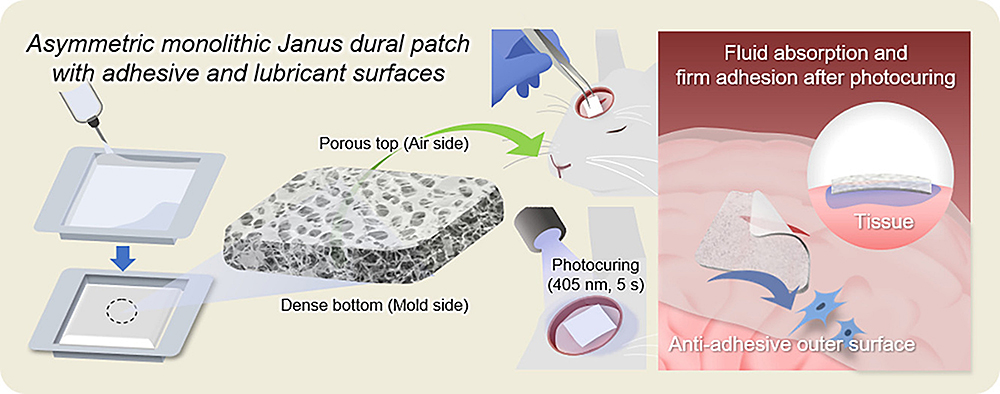
【광경화성 히알루론산 기반 야누스(Janus) 패치의 개략도】
동결건조된 광경화성 히알루론산 패치는 체액을 흡수하며 빠르게 조직 표면에 밀착되고,
광경화 이후 한쪽 면은 강한 접착력을, 다른 한쪽 면은 우수한 윤활성을 갖는 ‘야누스(Janus)’ 표면 특성을 나타낸다.
이러한 특성은 수술 시간을 단축하고 뇌척수액 누출을 효과적으로 억제해 수술 후 합병증 감소 및 환자 예후 개선에 기여할 것으로 전망된다.
현재, 광경화 듀라 실란트는 비임상 시험을 통해 안전성과 유효성을 검증했으며, 연내 임상시험 신청을 앞두고 있다. 기존 광가교 소재와는 달리 인체 적용이 가능한 수준의 안전성을 확보함에 따라, 향후 국내 최초의 체내형 광경화 의료기기 개발로 이어져 신경외과 수술 시간을 단축하고 뇌척수액 유출을 차단함으로써 환자 예후를 개선할 것으로 전망된다.
한편, 바이오헬스 시장조사기관인 Market Intelo(2024)에 따르면 글로벌 듀라 실란트 시장 규모는 2024년 약 4억 달러로 추산되며, 2033년에는 약 두 배가량 성장해 약 8억 달러 수준으로 확대될 것으로 예측된다.
양승윤 교수는 “광경화 기술은 이미 산업적으로 검증된 플랫폼 기술이지만, 의료분야에서는 안전성 확보가 가장 큰 과제로 남아 있었다”며 “이번 연구는 광가교 히알루론산 소재(HAMA-PA)의 인체 적용 가능성을 실질적으로 제시했다는 점에서 의미가 크다”고 강조했다. 또한 “해당 기술이 산업통상자원부로부터 신기술 인증을 받은 것은 기술적 완성도와 산업적 파급력을 동시에 인정받은 결과로, 향후 다양한 의료기기 및 치료 플랫폼으로 확장이 기대된다”고 덧붙였다.
공동연구자인 부산대병원 신경외과 남경협 교수(現 동의의료원)는 “경막봉합은 수술 성패와 직결되는 매우 중요한 단계로, 듀라 실란트는 안전성 확보 및 체내 시술 시 유효성 확보가 큰 과제였다”며 “이번에 개발된 듀라 실란트는 낮은 팽윤 특성과 우수한 생체적합성을 동시에 갖추고 있으며, 봉합에 필요한 시간이 단축되며 사용법이 용이해 실제 수술 현장에서 신경외과 의사들이 부담 없이 사용할 수 있는 현실적인 대안이 될 것”이라고 말했다.
에스엔비아 이강오 대표는 “부산대로부터 이전받은 기술을 기반으로 광가교 소재의 양산 시설을 구축했으며, 부산 공장 내에 의료기기 제조소도 확보했다”며 “중소벤처기업부(기술정보진흥원)가 지원하는 스케일업 팁스(TIPS) 과제를 통해 비임상시험을 완료하고 연내 임상시험계획서 제출을 위한 준비를 진행 중이며, 글로벌 파트너십 추진을 통해 광경화 의료소재 기반의 차세대 혁신의료기기 시장을 선도하겠다”는 포부를 전했다.
이번 연구는 부산대 바이오소재과학과 강수빈 연구원과 이혜선 박사가 공동 제1저자로 참여하고, 양승윤 교수가 교신저자를 맡아 부산대 제약학과 윤인수 교수, 부산대병원 남경협 교수와의 다학제 공동연구로 수행했다.
- 논문 제목: A monolithic Janus dural sealant with adhesive and lubricant surfaces activated by non-toxic visible light exposure(독성이 없는 가시광선에 의해 활성화되는 접착면과 윤활면을 동시에 가진 일체형 야누스 듀라 실란트)
- 논문 링크: https://doi.org/10.1016/j.cej.2025.171881
해당 연구는 중소벤처기업부 스케일업 팁스 및 과학기술정보통신부 글로벌기초연구실지원과제, 중견연구자지원과제 지원을 받았다.
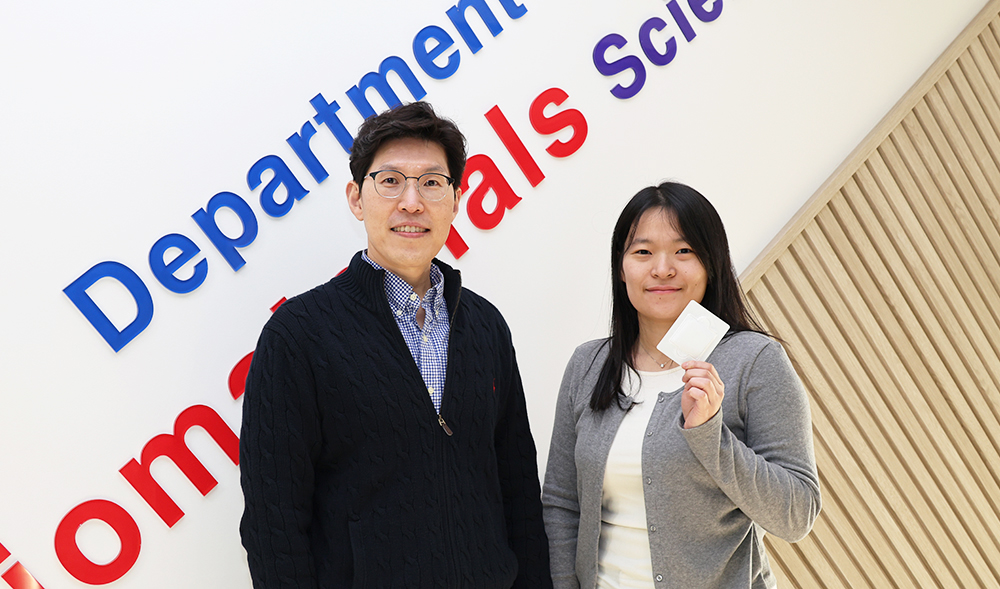
* 상단 연구진 사진: 왼쪽부터 양승윤 교수, 이혜선 박사.
[Abstract]
Developing Light-Activated Tissue Adhesive Patch for Rapid, Watertight Neurosurgical Sealing
Durotomy, a tear in the dura mater, is a common complication in neurosurgical procedures. The dura mater is a tough protective membrane that surrounds the brain and spinal cord, safeguarding the central nervous system. When this membrane is damaged, cerebrospinal fluid (CSF) can leak, leading to complications such as delayed wound healing, low-pressure headaches, and serious infections. Preventing CSF leakage, therefore, requires a reliable, watertight closure of the dura mater.
Tissue adhesives are increasingly explored as alternatives to suturing for dural closure because they offer simpler and faster application. However, many existing glue-based sealants suffer from excessive swelling, leading to mass effect, and unwanted tissue adhesion, which can lead to postoperative complications. To address these limitations, researchers have investigated Janus tissue patches, which feature two distinct surfaces—one that adheres strongly to tissue and another that prevents unwanted adhesion. Unfortunately, most existing Janus patches rely on multiple materials and complex, multi-step fabrication processes, limiting their practical use.
In a breakthrough study, a research team from South Korea led by Professor Seung Yun Yang from the Department of Biomaterials Science at Pusan National University has developed an innovative light-responsive, monolithic Janus dural patch using photocurable hyaluronic acid (HA) through a simple approach. “Made from natural biopolymer hyaluronic acid, our dural patch provides strong wet adhesion, along with a lubricating surface that prevents unwanted tissue adhesion, after exposure to non-toxic visible light,” explains Prof. Yang. Their study was made available online on December 16, 2025, and published in Volume 527 of Chemical Engineering Journal on January 01, 2026.
The researchers selected HA because of its excellent biocompatibility as well as its intrinsic anti-adhesive and lubricating properties. To enable light activation, HA was chemically modified with photocrosslinkable groups—methacrylate (MA) and 4-pentenoate (PA). The resulting HA-based solution was then lyophilized to form a patch with two distinct surfaces: a dense surface with a high polymer concentration and a porous surface with a lower polymer concentration. To further enhance conformal adhesion to wet tissues, the patch was compressed to a thickness of approximately 0.2 mm.
Laboratory tests showed that the patch could fully seal the wounds within five seconds using low-energy visible light. The dense outer surface exhibited strong wet adhesion, achieving high burst pressure and approximately 50% lower friction than conventional dural sealants. Notably, the adhesion strength was up to ten times higher than that of commercially available tissue adhesives. Meanwhile, the porous surface efficiently absorbed fluids and helped prevent unintended tissue adhesion. The patch also demonstrated minimal swelling and a reduced mass effect—less than 200% swelling and an approximately 0.1 g increase in weight—along with high stretchability, flexibility, and excellent biocompatibility.
The team also tested the developed patch in a rabbit durotomy model, where it achieved rapid and effective dural closure without causing damage to the surrounding skull, dura mater, or brain tissue. This photocurable dural patch has been transferred to the biotech company SNvia, where large-scale manufacturing facilities for photocrosslinkable HA have been established. Nonclinical studies are scheduled to be completed in the first half of 2026, and preparations are underway for submission of a medical device clinical trial application to the Ministry of Food and Drug Safety (MFDS, South Korea) within the same year.
“Our technology will allow surgeons to seal wounds rapidly, significantly reducing the risk of postoperative cerebrospinal fluid leakage,” remarks Prof. Yang. “While photocuring technologies are already well established as industrial platform technologies, ensuring safety has remained a major challenge in medical applications. This study is significant in that it provides practical evidence for the clinical applicability of photocrosslinkable hyaluronic acid (HAMA-PA). Its strong adhesion to wet tissues also opens new possibilities for drug-delivery patches, cell-laden constructs, and artificial tissues.”
Overall, this innovative dural patch holds great potential for use in diverse applications requiring rapid, watertight sealing.
- Author (Pusan National University): Seung Yun Yang (Department of Biomaterials Science)
- Title of original paper: A monolithic Janus dural sealant with adhesive and lubricant surfaces
- Journal: Chemical Engineering Journal
- Web link: https://doi.org/10.1016/j.cej.2025.171881
- Contact e-mail: syang@pusan.ac.kr