
PNU 리서치
- 메인으로 이동
- 연구/산학
- PNU 리서치
첨단융합학부 광메카트로닉스전공 정세영 명예교수 연구팀은 백금 등 고가의 희귀 금속 대신 구리 산화물을 활용해 차세대 저전력 반도체에 적용 가능한 핵심 기술을 개발했다.
연구팀은 구리(Cu)와 구리 산화물(Cu₂O)이 만나는 아주 얇은 경계면에서 전류를 자기(magnetic) 신호로 효율적으로 바꾸는 기술을 구현했다. 차세대 저전력 인공지능(AI) 반도체와 스핀트로닉스 소자의 핵심 기술로 주목받는 궤도-래시바*-에델슈타인** 효과(Orbital Rashba-Edelstein Effect, OREE)의 효율을 크게 높인 성과다.
* 래쉬바 효과: 구조적 비대칭성이 있는 계면이나 표면에서 전자가 움직일 때, 전자의 운동량과 스핀이 결합해 에너지 밴드의 스핀 분리가 발생하는 현상.
** 에델쉬타인 효과: 래쉬바 효과가 존재하는 계면에 전류를 흘리면 운동량 분포가 비대칭이 되면서 순 스핀 축적(net spin accumulation)이 발생하는 현상.
현재 차세대 메모리와 반도체 기술 분야에서는 전류를 이용해 정보를 저장하거나 바꾸는 연구가 활발히 진행되고 있다. 특히 스핀트로닉스 메모리 및 로직 소자에서는 전류로 자석의 자화 방향을 제어하고, 이를 0과 1의 정보로 활용하는 스핀-궤도 토크*(Spin-Orbit Torque)가 핵심 동작 원리로 쓰인다.
* 궤도 토크: 전류에 의해 생성된 궤도 각운동량이 자성체의 자기모멘트와 상호작용해 자화를 전환시키는 현상.
이 기술은 빠르고 전력 소모가 적어 차세대 반도체의 유력한 후보로 꼽힌다. 하지만 지금까지는 백금이나 텅스텐처럼 비싸고 무거운 금속이 주로 사용돼 왔다. 이들 금속은 성능은 좋지만 가격이 높고 전력 소모와 발열 문제가 있었다.
이와 달리, 연구팀은 산업 현장에서 쓰이는 구리를 활용했다. 구리는 전기가 잘 통하고 가격이 상대적으로 낮아 반도체 배선 등에 이미 널리 사용되고 있다.
연구팀은 원자 스퍼터링 에피택시(Atomic Sputtering Epitaxy, ASE) 기술을 이용해 세계 최고 수준의 단결정 구리 박막을 성장시킨 후, 그 표면을 정밀하게 산화시켜 결정성이 우수한 산화구리/구리 이종접합 구조를 제작했다. 구리와 산화구리가 만나는 경계면을 얼마나 깨끗하고 규칙적으로 만들 수 있는지가 중요했는데, 이 경계면의 결정성을 높이면 전류를 자기 제어 신호로 바꾸는 효율이 크게 향상됐기 때문이다.
그 결과, 이번에 만든 결정질 산화구리/구리 구조는 전류를 자기 제어 신호로 바꾸는 ‘궤도-래시바-에델슈타인 효과(OREE)’가 자연스럽게 산화된 구리보다 약 10배 향상됐다. 또한 이 과정에서 생성된 궤도 토크의 효율은 기존 스핀트로닉스 산업의 대표 소재인 백금 수준에 도달했다.
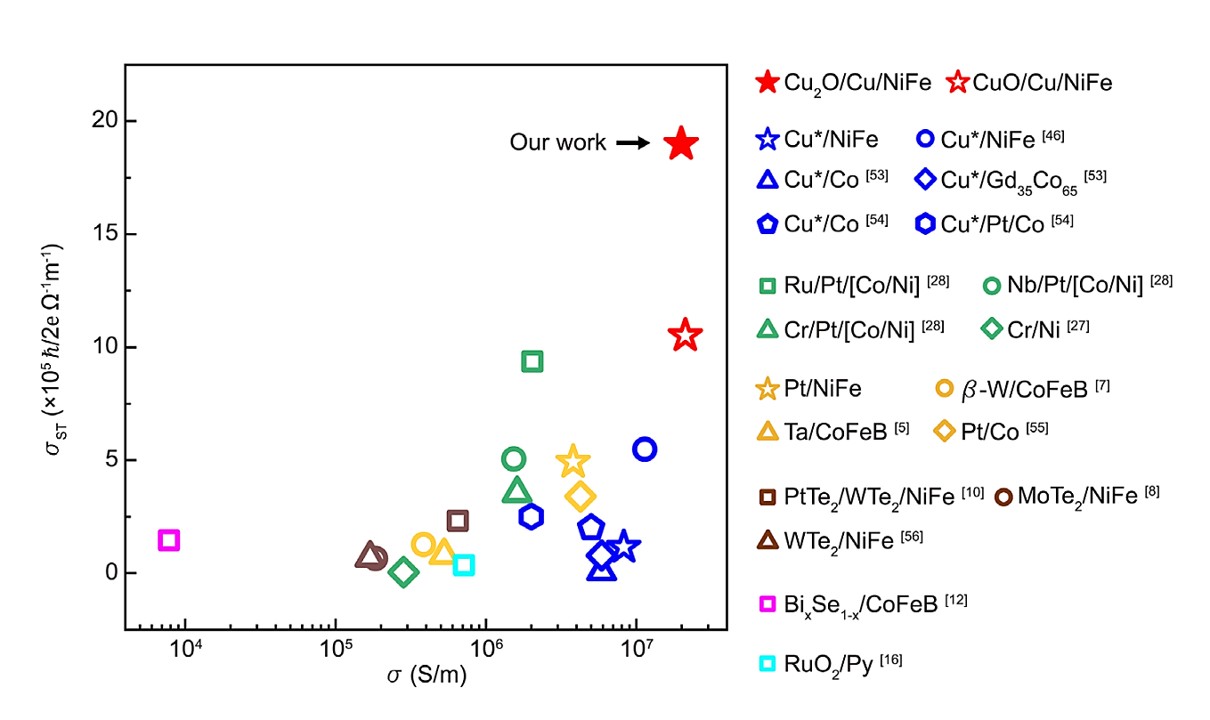
연구팀은 구리의 높은 전기전도도와 향상된 계면 효과가 결합되면서, 전류를 얼마나 효율적으로 자기 제어에 활용할 수 있는지를 보여주는 핵심 지표인 스핀 토크 전도도(Spin Torque Conductivity)가 세계 최고 수준에 도달했다고 설명했다. 이는 기존에 보고된 스핀 홀 효과(Spin Hall Effect) 기반 소재, 궤도 홀 효과(Orbital Hall Effect) 기반 소재, 위상절연체 및 반데르발스 물질을 포함한 다양한 차세대 스핀트로닉스 소재들을 능가하는 성능이다. 앞으로 비싼 중금속을 쓰지 않고도 저전력 메모리와 AI 반도체를 만들 수 있는 가능성으로 점쳐진다.
AI 반도체는 막대한 양의 데이터를 빠르게 처리해야 하기 때문에 전력 소모와 발열을 줄이는 것이 매우 중요하다. 이번 연구는 전기를 더 적게 쓰면서도 정보를 안정적으로 제어할 수 있는 새로운 길을 제시했다.
정세영 교수는 “이번 연구는 구리와 산화구리의 경계면을 정밀하게 제어하는 것만으로도 차세대 반도체에 필요한 성능을 크게 높일 수 있음을 보여줬다”며 “향후 저전력 스핀트로닉스 소자, AI 반도체, 차세대 메모리, 뉴로모픽 컴퓨팅 기술 개발에 폭넓게 활용될 수 있을 것으로 기대한다”고 말했다.

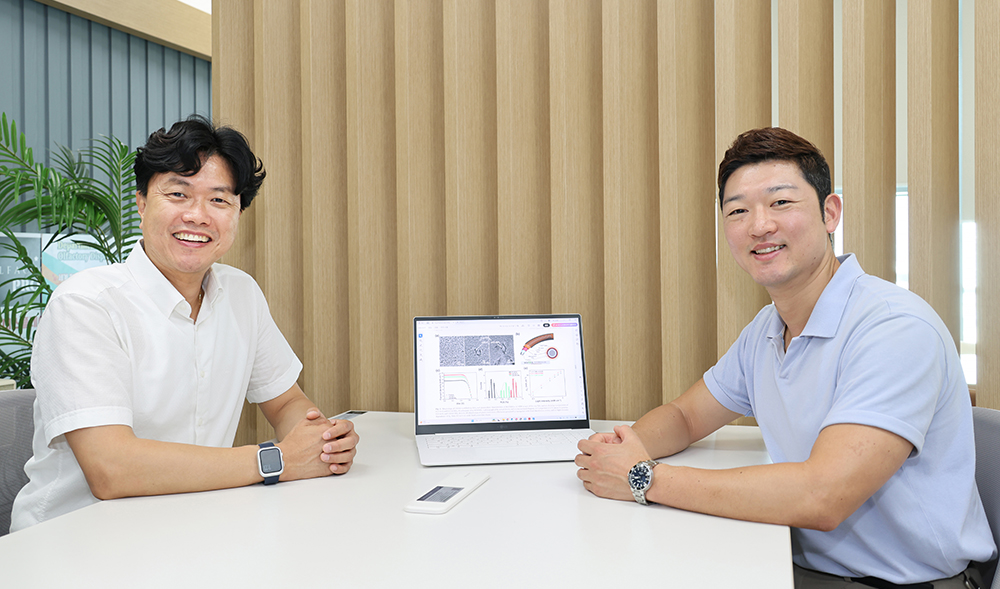
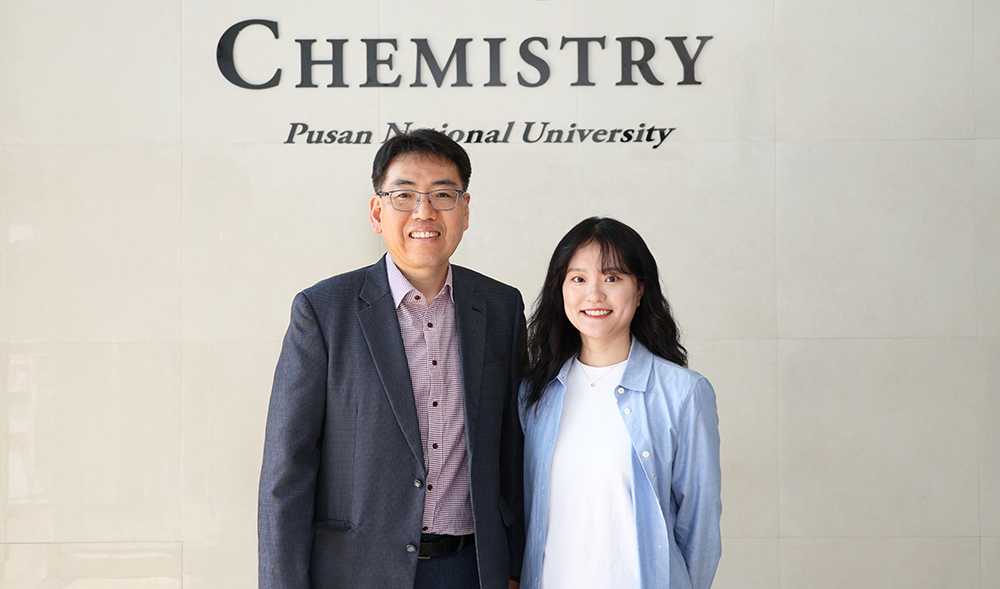
【왼쪽부터 정세영 교수, 김수재 박사】
이번 연구는 첨단융합학부 광메카트로닉스공학전공 및 컬러변조 초감각 인지기술 선도연구센터 정세영 교수가 교신저자, 단결정은행연구소 김수재 박사가 공동저자로 수행했으며, 카이스트 연구진과 공동으로 이뤄졌다. 연구 결과는 국제 학술지 『Advanced Materials』 5월 28일자 게재됐다.
- 논문 제목: Giant orbital Rashba-Edelstein effect in crystalline Cu₂O/Cu heterostructures (결정 Cu₂O/Cu 헤테로 구조에서 거대 궤도 라쉬바-에델쉬타인 효과)
- 논문 링크: https://doi.org/10.1002/adma.73522
* 상단 연구 이미지: 다양한 물질계에서의 스핀 토크 전도도(σST)와 전기전도도(σ) 비교
그래프 내에는 문헌에 보고된 결정 CuOx/Cu 계(red), 자연 산화된 Cu 기반 계(blue), 궤도 홀 효과(Orbital Hall Effect) 기반 물질(green), 스핀 홀 효과(Spin Hall Effect) 기반 물질(yellow), 반데르발스 물질(brown), 위상절연체(topological insulators, magenta), 그리고 알터자성체(altermagnets, cyan)가 포함된다. 별표(★)로 표시된 데이터는 이번 연구에서 얻은 결과를 나타낸다.
[Abstract]
Orbital current-induced torque (OT) has emerged as a promising alternative to spin-orbit torque owing to the typically larger orbital Hall conductivity. A substantial OT can be generated at metal/oxide interfaces via the orbital Rashba-Edelstein effect (OREE), which has been predominantly reported in surface-oxidized Cu structures. However, the lack of a well-defined crystalline and interfacial structures in oxidized Cu has hindered a clear understanding of the underlying mechanism and limited further enhancement of OT. Here, we demonstrate a significantly enhanced OREE in crystalline CuOx/Cu heterostructures with well-defined interfaces. By employing controlled oxidation of single-crystalline Cu, we fabricate crystalline CuOx layers with distinct chemical phases and quantify the resulting OT using harmonic Hall measurements. We find that the crystalline Cu₂O/Cu heterostructure exhibits a damping-like OT efficiency approximately seven times larger than that of naturally oxidized Cu, highlighting the crucial role of structural ordering and interface sharpness. Notably, this large OT efficiency, combined with the high electrical conductivity of Cu, yields a spin torque conductivity of 2.1×10⁶ (ℏ/2e)Ω-1m-1, exceeding that of Pt. These results establish crystalline Cu₂O/Cu heterostructures as a promising platform for ultralow-power spin-orbitronic devices.
- Authors (Pusan National University)
· First author: Su Jae Kim (Crystal Bank Research Institute)
· Corresponding author: Se-Young Jeong (Department of Optics and Mechatronics Engineering, Engineering Research Center for Color-Modulated Extra-Sensory Perception Technology)
- Title of original paper: Giant orbital Rashba-Edelstein effect in crystalline Cu₂O/Cu heterostructures
- Journal: Advanced Materials
- Web link: https://doi.org/10.1002/adma.73522
- Contact e-mail: syjeong@pusan.ac.kr
-
구리 산화막 제어해 차세대 반도체 핵심 효율 세계 최고 수준 달성
첨단융합학부/_UPLOAD/IMAGE/Board/68/2026/10/q7jGCpMbCaHS2vaU.JPG첨단융합학부정세영 명예교수팀, 값싼 구리로 저전력 AI 반도체 길 열었다구리 산화막 제어해 차세대 반도체 핵심 효율 세계 최고 수준 달성
첨단융합학부 광메카트로닉스전공 정세영 명예교수 연구팀은 백금 등 고가의 희귀 금속 대신 구리 산화물을 활용해 차세대 저전력 반도체에 적용 가능한 핵심 기술을 개발했다.연구팀은 구리(Cu)와 구리 산화물(Cu₂O)이 만나는 아주 얇은 경계면에서 전류를 자기(magnetic) 신호로 효율적으로 바꾸는 기술을 구현했다. 차세대 저전력 인공지능(AI) 반도체와 스핀트로닉스 소자의 핵심 기술로 주목받는 궤도-래시바*-에델슈타인** 효과(Orbital Rashba-Edelstein Effect, OREE)의 효율을 크게 높인 성과다.
* 래쉬바 효과: 구조적 비대칭성이 있는 계면이나 표면에서 전자가 움직일 때, 전자의 운동량과 스핀이 결합해 에너지 밴드의 스핀 분리가 발생하는 현상.
** 에델쉬타인 효과: 래쉬바 효과가 존재하는 계면에 전류를 흘리면 운동량 분포가 비대칭이 되면서 순 스핀 축적(net spin accumulation)이 발생하는 현상.
현재 차세대 메모리와 반도체 기술 분야에서는 전류를 이용해 정보를 저장하거나 바꾸는 연구가 활발히 진행되고 있다. 특히 스핀트로닉스 메모리 및 로직 소자에서는 전류로 자석의 자화 방향을 제어하고, 이를 0과 1의 정보로 활용하는 스핀-궤도 토크*(Spin-Orbit Torque)가 핵심 동작 원리로 쓰인다.
* 궤도 토크: 전류에 의해 생성된 궤도 각운동량이 자성체의 자기모멘트와 상호작용해 자화를 전환시키는 현상.
이 기술은 빠르고 전력 소모가 적어 차세대 반도체의 유력한 후보로 꼽힌다. 하지만 지금까지는 백금이나 텅스텐처럼 비싸고 무거운 금속이 주로 사용돼 왔다. 이들 금속은 성능은 좋지만 가격이 높고 전력 소모와 발열 문제가 있었다.
이와 달리, 연구팀은 산업 현장에서 쓰이는 구리를 활용했다. 구리는 전기가 잘 통하고 가격이 상대적으로 낮아 반도체 배선 등에 이미 널리 사용되고 있다.
연구팀은 원자 스퍼터링 에피택시(Atomic Sputtering Epitaxy, ASE) 기술을 이용해 세계 최고 수준의 단결정 구리 박막을 성장시킨 후, 그 표면을 정밀하게 산화시켜 결정성이 우수한 산화구리/구리 이종접합 구조를 제작했다. 구리와 산화구리가 만나는 경계면을 얼마나 깨끗하고 규칙적으로 만들 수 있는지가 중요했는데, 이 경계면의 결정성을 높이면 전류를 자기 제어 신호로 바꾸는 효율이 크게 향상됐기 때문이다.
그 결과, 이번에 만든 결정질 산화구리/구리 구조는 전류를 자기 제어 신호로 바꾸는 ‘궤도-래시바-에델슈타인 효과(OREE)’가 자연스럽게 산화된 구리보다 약 10배 향상됐다. 또한 이 과정에서 생성된 궤도 토크의 효율은 기존 스핀트로닉스 산업의 대표 소재인 백금 수준에 도달했다.
연구팀은 구리의 높은 전기전도도와 향상된 계면 효과가 결합되면서, 전류를 얼마나 효율적으로 자기 제어에 활용할 수 있는지를 보여주는 핵심 지표인 스핀 토크 전도도(Spin Torque Conductivity)가 세계 최고 수준에 도달했다고 설명했다. 이는 기존에 보고된 스핀 홀 효과(Spin Hall Effect) 기반 소재, 궤도 홀 효과(Orbital Hall Effect) 기반 소재, 위상절연체 및 반데르발스 물질을 포함한 다양한 차세대 스핀트로닉스 소재들을 능가하는 성능이다. 앞으로 비싼 중금속을 쓰지 않고도 저전력 메모리와 AI 반도체를 만들 수 있는 가능성으로 점쳐진다.
AI 반도체는 막대한 양의 데이터를 빠르게 처리해야 하기 때문에 전력 소모와 발열을 줄이는 것이 매우 중요하다. 이번 연구는 전기를 더 적게 쓰면서도 정보를 안정적으로 제어할 수 있는 새로운 길을 제시했다.
정세영 교수는 “이번 연구는 구리와 산화구리의 경계면을 정밀하게 제어하는 것만으로도 차세대 반도체에 필요한 성능을 크게 높일 수 있음을 보여줬다”며 “향후 저전력 스핀트로닉스 소자, AI 반도체, 차세대 메모리, 뉴로모픽 컴퓨팅 기술 개발에 폭넓게 활용될 수 있을 것으로 기대한다”고 말했다.
【왼쪽부터 정세영 교수, 김수재 박사】
이번 연구는 첨단융합학부 광메카트로닉스공학전공 및 컬러변조 초감각 인지기술 선도연구센터 정세영 교수가 교신저자, 단결정은행연구소 김수재 박사가 공동저자로 수행했으며, 카이스트 연구진과 공동으로 이뤄졌다. 연구 결과는 국제 학술지 『Advanced Materials』 5월 28일자 게재됐다.
- 논문 제목: Giant orbital Rashba-Edelstein effect in crystalline Cu₂O/Cu heterostructures (결정 Cu₂O/Cu 헤테로 구조에서 거대 궤도 라쉬바-에델쉬타인 효과)
- 논문 링크: https://doi.org/10.1002/adma.73522
* 상단 연구 이미지: 다양한 물질계에서의 스핀 토크 전도도(σST)와 전기전도도(σ) 비교
그래프 내에는 문헌에 보고된 결정 CuOx/Cu 계(red), 자연 산화된 Cu 기반 계(blue), 궤도 홀 효과(Orbital Hall Effect) 기반 물질(green), 스핀 홀 효과(Spin Hall Effect) 기반 물질(yellow), 반데르발스 물질(brown), 위상절연체(topological insulators, magenta), 그리고 알터자성체(altermagnets, cyan)가 포함된다. 별표(★)로 표시된 데이터는 이번 연구에서 얻은 결과를 나타낸다.
[Abstract]
Orbital current-induced torque (OT) has emerged as a promising alternative to spin-orbit torque owing to the typically larger orbital Hall conductivity. A substantial OT can be generated at metal/oxide interfaces via the orbital Rashba-Edelstein effect (OREE), which has been predominantly reported in surface-oxidized Cu structures. However, the lack of a well-defined crystalline and interfacial structures in oxidized Cu has hindered a clear understanding of the underlying mechanism and limited further enhancement of OT. Here, we demonstrate a significantly enhanced OREE in crystalline CuOx/Cu heterostructures with well-defined interfaces. By employing controlled oxidation of single-crystalline Cu, we fabricate crystalline CuOx layers with distinct chemical phases and quantify the resulting OT using harmonic Hall measurements. We find that the crystalline Cu₂O/Cu heterostructure exhibits a damping-like OT efficiency approximately seven times larger than that of naturally oxidized Cu, highlighting the crucial role of structural ordering and interface sharpness. Notably, this large OT efficiency, combined with the high electrical conductivity of Cu, yields a spin torque conductivity of 2.1×10⁶ (ℏ/2e)Ω-1m-1, exceeding that of Pt. These results establish crystalline Cu₂O/Cu heterostructures as a promising platform for ultralow-power spin-orbitronic devices.
- Authors (Pusan National University)
· First author: Su Jae Kim (Crystal Bank Research Institute)
· Corresponding author: Se-Young Jeong (Department of Optics and Mechatronics Engineering, Engineering Research Center for Color-Modulated Extra-Sensory Perception Technology)
- Title of original paper: Giant orbital Rashba-Edelstein effect in crystalline Cu₂O/Cu heterostructures
- Journal: Advanced Materials
- Web link: https://doi.org/10.1002/adma.73522
- Contact e-mail: syjeong@pusan.ac.kr
-
UiO-66 금속유기골격체(MOF) 적용…섬유형 태양전지 효율 29% 향상·황화...
첨단융합학부/_UPLOAD/IMAGE/Board/68/2026/10/B0L8HC6zopf932HQ.JPG첨단융합학부이형우 교수팀, 전기 만들고 유해가스 감지하는 '스마트 전자섬유' 개발UiO-66 금속유기골격체(MOF) 적용…섬유형 태양전지 효율 29% 향상·황화수소 감지 기능 구현
첨단융합학부 미래에너지전공 및 휴머노이드 후각디스플레이센터 이형우 교수 연구팀이 금속유기골격체(MOF)인 UiO-66을 활용한 섬유형 염료감응 태양전지 기반 다기능 전자섬유 플랫폼을 개발했다. 섬유형 태양전지의 발전 효율을 높이는 동시에 유해가스인 황화수소(H₂S)를 감지할 수 있는 다기능 스마트 전자섬유로, 스마트 의류와 웨어러블 전자기기, 산업안전 모니터링 분야에 적용 가능한 자가발전형 센서 플랫폼으로 활용될 수 있을 것으로 기대된다.최근 스마트 의류, 웨어러블 전자기기, 사물인터넷(IoT) 기술이 빠르게 발전하면서 몸에 착용할 수 있고 유연하게 구부러지는 섬유형 전자소자에 대한 관심이 커지고 있다. 특히 섬유형 태양전지는 인체 활동 중에도 빛을 이용해 전력을 생산할 수 있어 차세대 웨어러블 전원으로 주목받고 있다.
하지만 기존 섬유형 태양전지는 발전 효율이 제한적이고, 실내와 같은 저조도 환경에서는 성능이 떨어지는 한계가 있었다. 또한 대부분 전력 생산 기능에 초점이 맞춰져 있어 가스 감지나 환경 모니터링 등 추가 기능을 동시에 구현하기 어려웠다.
연구팀은 이러한 한계를 해결하기 위해 높은 기공도와 넓은 표면적을 가진 금속유기골격체인 UiO-66에 주목했다. UiO-66은 금속 이온과 유기 분자가 규칙적으로 연결된 다공성 소재로, 기체 흡착 능력이 뛰어나 에너지·환경 분야에서 차세대 기능성 소재로 주목받고 있다.
연구진은 불소(F) 및 아미노기(NH2)가 도입된 UiO-66 MOF를 합성하고, 이를 섬유형 염료감응 태양전지의 광전극 소재인 이산화티타늄(TiO₂)에 적용했다. 그 결과 염료 분자가 흡착할 수 있는 표면적이 증가하고 전하 이동 특성이 개선되면서 광전류 생성과 전하 수집 효율이 향상됐다.

【기능성 UiO-66 MOF 기반 섬유형 태양전지 및 황화수소 가스센서】특히 UiO-66-F가 적용된 섬유형 태양전지는 기존 소자 대비 최대 29% 향상된 7.16%의 광전변환효율(PCE)을 달성했다. 실내 조명 환경에서도 우수한 발전 성능을 보여 웨어러블 전자기기용 자가발전 소자로서의 활용 가능성을 확인했다.
이번 연구를 통해 연구팀은 태양에너지 수확 기능과 유해가스 감지 기능을 하나의 섬유 플랫폼에 통합했다. 연구팀은 UiO-66-F가 황화수소 가스를 선택적으로 흡착하는 특성을 활용해 섬유형 가스센서 기능을 구현했다. 황화수소는 하수처리장, 석유화학 공정, 산업시설 등에서 발생하는 대표적인 독성 가스로, 인체에 유해하기 때문에 실시간 감지가 중요하다.
실험 결과 UiO-66-F가 적용된 소자는 100 ppm의 황화수소 가스에 대해 약 97%의 높은 감응 특성을 나타냈으며, 빠른 응답 및 회복 특성도 보였다. 기존 TiO2 기반 소자에서는 나타나지 않던 우수한 가스 감지 성능을 확보함으로써, 하나의 전자섬유가 전력을 생산하면서 동시에 주변 환경의 유해가스를 감지할 수 있음을 입증했다.
또한 개발된 전자섬유는 1,500회 이상의 반복 굽힘 시험과 20회의 세탁 시험 이후에도 초기 성능의 70~80% 이상을 유지해, 실제 의류나 웨어러블 기기에 적용하기 위해 필요한 기계적 안정성과 내구성을 갖췄다.
이형우 교수는 “이번 연구는 섬유형 태양전지의 에너지 생산 성능을 향상시키는 동시에 유해가스 감지 기능까지 구현함으로써 하나의 전자섬유에서 에너지 수확과 환경 모니터링을 동시에 수행할 수 있는 가능성을 제시했다”며 “향후 스마트 의류, 웨어러블 전자기기, 산업안전 모니터링 시스템 등 다양한 분야에 활용될 수 있을 것으로 기대된다”고 말했다.
이번 연구는 과학기술정보통신부 집단연구사업인 글로벌연구센터 사업과 과학기술정보통신부 한국재료연구원 기본사업의 지원을 받아 부산대·한국재료연구원(KIMS) 공동연구로 수행됐다. 부산대 첨단융합학부 미래에너지전공 및 휴머노이드 후각디스플레이센터 이형우 교수가 교신저자, 휴머노이드 후각디스플레이센터 김재호 박사가 제1저자 및 교신저자로 참여했다.
해당 논문은 국제학술지 『Chemical Engineering Journal』 9월 1일자에 게재됐다.
- 논문 제목: Dual functional enhancement of H2S gas sensing and fiber dye-sensitized solar cell efficiency using UiO-66 MOFs (UiO-66 MOF를 이용한 황화수소 가스 감지 및 섬유형 염료감응 태양전지 효율의 동시 향상)
- 논문 링크: https://doi.org/10.1016/j.cej.2026.178271
※ 용어 설명
- 금속유기골격체(MOF, Metal–Organic Framework): 금속 이온과 유기 분자가 규칙적으로 연결된 다공성 신소재. 표면적이 넓고 기체 흡착 능력이 우수해 에너지 저장, 환경 감지, 촉매, 가스 분리 등 다양한 분야에서 활용 가능성이 크다.
- 섬유형 염료감응 태양전지(FDSSC): 연필심 정도의 가느다란 섬유 형태로 제작되는 태양전지. 유연하고 가벼워 옷감이나 웨어러블 전자기기에 적용하기 쉽고, 빛을 이용해 전기를 생산할 수 있다.
- 황화수소(H2S): 하수처리장, 석유화학 공정, 산업시설 등에서 발생할 수 있는 독성 가스. 특유의 냄새가 있으며 고농도 노출 시 인체에 위험할 수 있어 실시간 감지가 중요하다.
- 광전변환효율(PCE, Power Conversion Efficiency): 태양전지가 받은 빛 에너지를 전기 에너지로 얼마나 효율적으로 바꾸는지를 나타내는 지표다. 수치가 높을수록 같은 빛 조건에서 더 많은 전기를 생산할 수 있다.
* 상단 연구진 사진: 왼쪽부터 이형우 교수, 김재호 박사.
[Abstract]
A collaborative research team led by Professor Hyung Woo Lee of the School of Advanced Convergence for Future Energy Major and the Humanoid Olfactory Display Innovation Research Center at Pusan National University, in collaboration with Dr. Myungkwan Song's team at the Korea Institute of Materials Science (KIMS), has developed a multifunctional electronic fiber capable of simultaneously harvesting solar energy and detecting hazardous gases through the incorporation of UiO-66 metal–organic x-x-frameworks (MOFs). Dr. Jae Ho Kim of Pusan National University served as the first and corresponding author of the study.
Wearable electronics that combine energy harvesting and environmental sensing in a single platform are highly desirable for next-generation smart textiles. Here, fluorine- and amino-functionalized UiO-66 metal–organic x-x-frameworks (MOFs) are incorporated into mesoporous TiO2 photoanodes to develop multifunctional electronic fibers capable of simultaneous solar energy harvesting and hazardous gas detection. The MOF-modified photoanodes provide increased surface area for dye adsorption and facilitate charge transport, yielding a power conversion efficiency of 7.16% for the UiO-66-F-based fiber-shaped dye-sensitized solar cell, a ~29% improvement over the pristine device, along with superior photocurrent generation under low-light indoor conditions. The same fiber platform is further integrated with gas-sensing functionality: owing to the strong affinity of UiO-66-F toward H2S, the fiber sensor exhibits a high response of ~97% toward 100 ppm H2S with rapid response and recovery, whereas pristine TiO2-based fibers show negligible sensing performance. The fibers retain more than 70–80% of their initial performance after repeated bending and washing, confirming their mechanical durability. This work presents a unified strategy for integrating energy harvesting and gas sensing into a single fiber architecture, offering a promising route toward self-powered wearable sensors, smart clothing, and IoT-based environmental monitoring platforms.
- Authors (Pusan National University)
· Corresponding author: Hyung Woo Lee (Advanced Energy Major, School of Transdisciplinary Engineering and Humanoid Olfactory Display Innovation Research Center)
· First author & Corresponding author: Jae Ho Kim (Humanoid Olfactory Display Innovation Research Center)
- Title of original paper: Dual functional enhancement of H2S gas sensing and fiber dye-sensitized solar cell efficiency using UiO-66 MOFs
- Journal: Chemical Engineering Journal
- Web link: https://doi.org/10.1016/j.cej.2026.178271
- Contact e-mail: lhw2010@pusan.ac.kr
-
광증착법 활용한 해수전해 촉매 개발 성공
화학과/_UPLOAD/IMAGE/Board/68/2026/10/wDtkX85KLn8CVpxy.JPG화학과남기민 교수팀, 바닷물로 살균수 만든다광증착법 활용한 해수전해 촉매 개발 성공
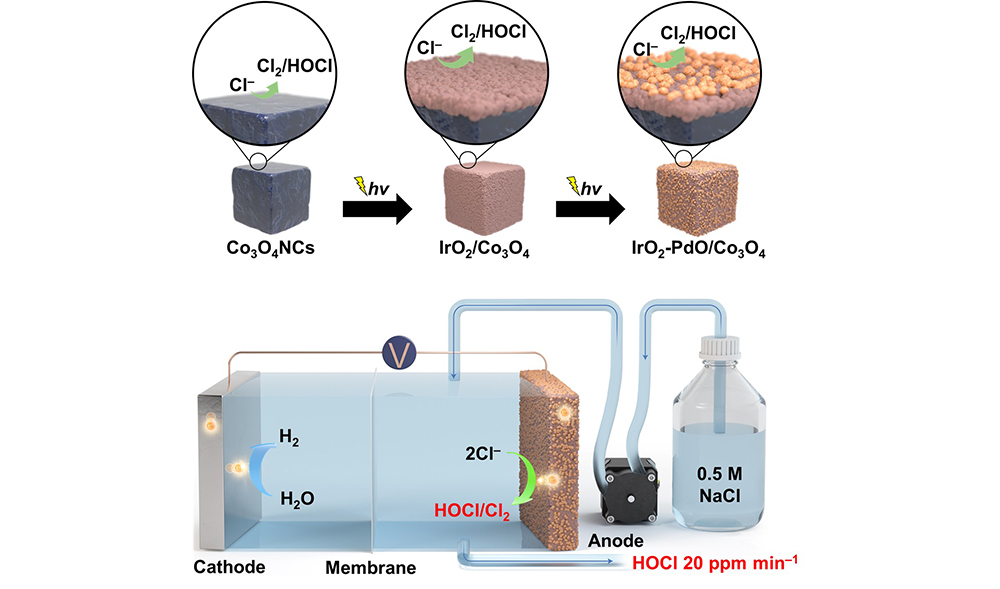
화학과 남기민 교수팀이 해수전해 산화 반응에서 산소 발생은 줄이고 염소이온 반응은 선택적으로 촉진하는 고성능 이종계면 촉매를 개발했다. 바닷물이나 염소이온이 들어 있는 전해질을 이용해 살균 성분인 차아염소산을 현장에서 바로 생산하는 기술로, 살균·소독 공정의 효율을 높이고, 해수 기반 친환경 전기화학 공정과 염소이온 함유 수계 전기화학 시스템 등 활용 범위가 넓을 것으고 기대된다.연구팀은 Co₃O₄(산화코발트) 나노큐브 표면에 IrO₂(이산화이리듐)와 PdO(산화팔라듐)를 순차적으로 광증착해 IrO₂-PdO/Co₃O₄ 이종계면 촉매를 합성했다. 개발된 촉매는 0.5 M NaCl 전해질[(염화나트륨(NaCl, 소금)이 0.5 mol/L 농도로 녹아 있는 전해질] 등 해수 조건에서 산소 발생 반응을 효과적으로 억제하면서 염소 이온 산화 반응을 선택적으로 촉진했으며, 높은 HOCl(차아염소산) 생성 효율과 우수한 장기 안정성을 보였다.
해수 또는 염소이온이 포함된 전해질을 이용한 전기화학 반응에서는 환원전극에서 수소 발생 반응이 일어나고, 산화전극에서는 산소 발생 반응과 염소 이온 산화 반응이 경쟁적으로 진행된다. 이 가운데 염소 이온 산화 반응을 선택적으로 유도하면 살균·소독에 활용 가능한 염소 기체 또는 차아염소산을 생산할 수 있다. 그러나 기존 촉매는 높은 염소 이온 산화 선택성과 장기 구동 안정성을 동시에 확보하는 데 한계가 있었다.
연구팀은 이 문제를 해결하기 위해 기능이 서로 다른 금속 산화물을 한 촉매 표면에 정밀하게 배치했다. 광증착법은 빛을 이용해 금속 산화물 나노입자를 촉매 표면에 형성하는 합성법으로, 상온에서 증착 순서와 조성을 제어할 수 있다는 장점이 있는데, 연구팀은 이를 활용해 Co₃O₄ 나노큐브 표면에 IrO₂와 PdO를 순차적으로 도입하고, 약 1 nm 크기의 IrO₂-PdO 나노입자를 균일하게 형성했다.
PdO는 염소 이온 산화 반응에 대한 높은 선택성을 제공하고, IrO₂S는 촉매 구조의 안정성 향상에 기여한다. 연구팀은 두 산화물이 접촉하는 IrO₂-PdO 이종계면을 의도적으로 구축함으로써 선택성과 안정성이라는 두 가지 성능을 동시에 끌어올렸다. Pd와 Ir은 각각 1% 이내의 소량만 사용됐음에도 0.5 M NaCl 전해질에서 산소 발생 반응을 억제하고 염소이온 산화 반응을 선택적으로 촉진했으며, 낮은 염 농도 조건에서도 우수한 선택성을 보였다.
개발된 촉매는 연속 흐름 조건에서도 차아염소산을 안정적으로 생산하고, 장시간 구동에도 성능을 유지해 해수 기반 현장형 차아염소산 생산 기술로의 활용 가능성을 보였다.
이번 연구는 해수 기반 전기화학 반응에서 촉매의 선택성과 내구성을 동시에 높일 수 있는 설계 원리를 제시한 것으로, 살균·소독용 차아염소산의 현장 생산, 해수전해 기반 친환경 화학 공정, 염소이온 함유 수계 전기화학 시스템 등에 활용될 것으로 기대된다.
남기민 교수는 “해수전해 연구는 선택성과 안정성이라는 두 가지 걸림돌을 동시에 해결해야 하는 연구 분야”라며 “이번 연구는 PdO와 IrO₂의 기능을 이종계면에서 결합함으로써 선택적인 염소 이온 산화 반응과 장기 안정성을 함께 향상시켰다”고 말했다.

【왼쪽부터 남기민 교수, 박준용 연구원】
부산대·경희대 공동연구로 수행된 이번 성과는 한국연구재단 중견연구사업, 선도연구센터(SRC) 사업 및 세종과학펠로우십 국내 사업의 지원을 받았다. 부산대 화학과 박준용 연구원이 제1저자, 남기민 교수가 공동 교신저자로, 국제 학술지 『ACS Energy Letters』 5월 8일자에 논문이 게재됐다.
- 논문 제목: Deliberate Construction of IrO₂-PdO Heterointerfaces via Sequential Photodeposition for Selective and Durable Chloride Oxidation (순차적 광증착 제어를 통한 IrO₂-PdO 이종계면 기반 고선택성 고내구성 염소 이온 산화 촉매 개발)
- 논문 링크: https://doi.org/10.1021/acsenergylett.6c00805
* 상단 연구 이미지: 순차적 광증착으로 합성한 IrO₂-PdO/Co₃O₄ 이종계면 촉매와 연속흐름 전해 시스템을 통한 수소 및 차아염소산 생성 모식도.
[Abstract]
A sequential photodeposition strategy was developed to construct IrO₂-PdO heterointerfaces on Co₃O₄ nanocubes for selective chloride oxidation. The resulting catalyst achieved nearly 100% HOCl production efficiency in neutral NaCl electrolyte by suppressing the competing oxygen evolution reaction. Experimental and theoretical analyses revealed that the IrO₂-PdO heterointerface enhances chloride oxidation activity and durability by optimizing Cl* adsorption and stabilizing the catalytic structure. These findings suggest a practical catalyst design strategy for seawater-relevant chloride oxidation and continuous disinfectant production.
- Authors (Pusan National University, Department of Chemistry)
· Corresponding author: Ki Min Nam
· First author: Joon Yong Park
- Title of original paper: Deliberate Construction of IrO₂-PdO Heterointerfaces via Sequential Photodeposition for Selective and Durable Chloride Oxidation
- Journal: ACS Energy Letters
- Web link: https://doi.org/10.1021/acsenergylett.6c00805
- Contact e-mail: kimin.nam@pusan.ac.kr
-
북한 6차 핵실험 후 '잠자던 단층' 다시 움직였다
지질환경과학과/_UPLOAD/IMAGE/Board/68/2026/9/9yJnwCar08xcwSaj.JPG지질환경과학과김광희 교수팀, 『사이언스』 논문 발표북한 6차 핵실험 후 '잠자던 단층' 다시 움직였다
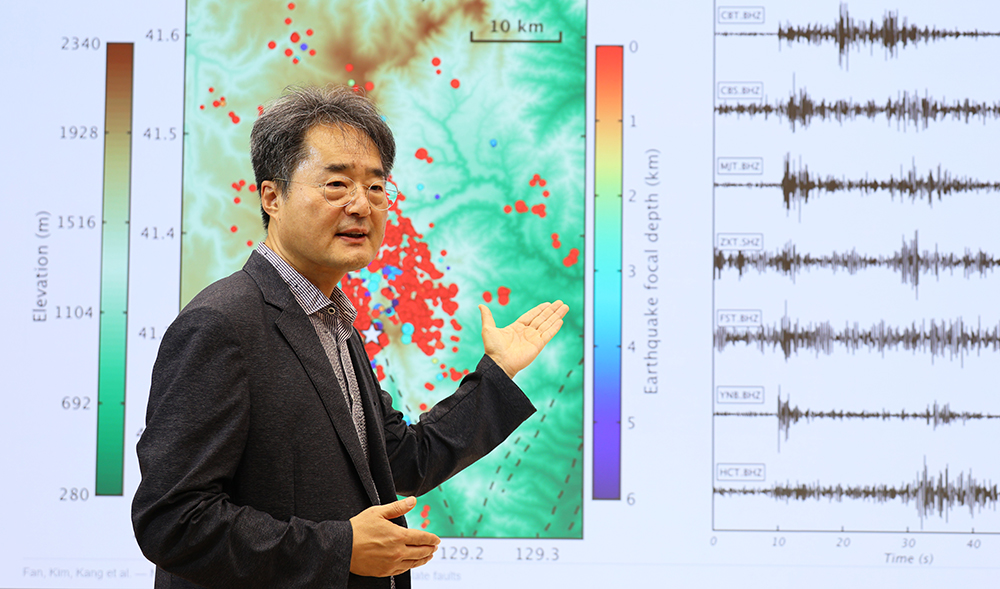
지질환경과학과 김광희(사진) 교수 연구팀이 17년간 축적된 지진 관측자료를 바탕으로 북한 풍계리 만탑산 일대에서 2017년 6차 지하핵실험 이후 기존 단층대가 수년에 걸쳐 점진적으로 재활성화됐음을 규명했다. 핵실험 이후 지진활동이 단기간에 잦아드는 일반적 양상과 달리, 만탑산에서는 지진활동이 수년간 증가하고 두 개의 북북서 방향 기존 단층대를 따라 점차 뚜렷하게 조직화된 것으로 확인됐다.연구팀은 중국 청두이공대학교 판싱리(Xingli Fan) 교수팀, 중국과학원, 중국지진국, 산둥대학교 연구진과 공동으로 한국과 중국 동북부에서 관측한 연속 지진파 자료를 분석해, 북한 만탑산 주변의 장기 지진활동과 기존 단층의 점진적인 재활성화 양상을 규명했다.
이번 연구 결과는 9월 17일(미국 동부시간) 세계적 권위의 국제 학술지 『사이언스(Science)』에 ‘Nuclear tests at Mt. Mantap have reactivated intraplate faults(북한 풍계리 핵실험이 만탑산의 잠자던 단층을 다시 움직였다)’라는 논문 제목으로 게재됐다. 판싱리 교수와 김광희 교수는 공동 제1저자이자 공동 교신저자로 연구를 이끌었다.
- 논문 링크: https://doi.org/10.1126/science.adx5917
일반적으로 지하핵실험 직후에는 다수의 작은 지진이나 붕괴 사건이 발생할 수 있다. 그러나 미국 네바다와 옛 소련 세미팔라틴스크 실험장 사례처럼 이러한 활동은 핵실험 후 수일에서 수주 사이에 감소하는 것으로 알려져 있다.
반면, 만탑산에서는 다른 양상이 확인됐다. 북한은 2006년부터 2017년까지 만탑산 풍계리 일대에서 모두 6차례 지하핵실험을 실시했으며, 특히 규모가 가장 컸던 2017년 6차 핵실험 이후 지진활동은 단기간에 그치지 않고 수년간 지속적으로 증가했다.

【만탑산 일대의 지형과 지진 분포】배경색은 고도, 원의 크기는 지진 규모, 원의 색은 추정 진원 깊이를 나타낸다.
흰색 별은 2017년 6차·최대 지하핵실험 위치이며, 검은 점선은 기존 지질도에서 디지털화한 단층선이다.
지진은 핵실험장으로부터 북북서 방향으로 뻗은 두 개의 거의 평행한 구조를 이룬다.연구팀은 한국과 중국 동북부에서 관측한 17년간의 연속 지진파 자료를 분석해, 2017년 핵실험 이후 지진활동이 잠잠했던 두 개의 북북서 방향 기존 단층대를 따라 집중적으로 발생하고 시간이 지날수록 더욱 뚜렷한 분포를 보였다는 사실을 확인했다.
연구팀은 반복된 핵실험이 만탑산 지각 천부에 균열과 손상을 누적시키고 주변 응력장을 변화시킨 뒤, 시간이 흐르면서 응력이 재분배되는 과정에서 이미 임계응력에 가까운 상태였던 기존 단층의 미끄러짐을 촉진한 것으로 해석했다.
핵폭발 자체가 끝난 이후에도 지하 암반 내부에서는 손상과 응력 변화의 영향이 장기간 지속될 수 있으며, 이 과정에서 잠자고 있던 기존 단층이 다시 움직이고 이에 따른 지진활동이 수년 동안 이어질 수 있다는 것이다.

【동영상 - 만탑산 지진활동의 시간적 전개】https://www.pusan.ac.kr/kor/ajx_json/UploadMgr/downloadRun.do?qcode=Q29tbW9uRmlsZSw0MTA4NDcsWQ==
2013년 5월 27일부터 2025년 5월 1일까지 지진을 시간순으로 보여준다.
보라색 별은 3-6차 지하핵실험, 원은 진앙, 원의 색은 지진발생 깊이를 나타낸다.
2017년 6차 핵실험 이후 지진활동이 수년간 이어지며 단층 구조를 따라 조직적으로 발생하는 모습을 확인할 수 있다.이번 연구는 지하핵실험 후 지진활동이 반드시 단기간에 종료되는 것이 아니라, 지질 조건과 기존 단층의 응력 상태에 따라 수년에 걸쳐 진화할 수 있음을 보여준다. 이는 핵실험 이후 발생하는 지진을 단기적 현상으로만 해석해서는 안 되며, 장기 지진목록과 물리적 맥락을 함께 고려해야 한다는 점을 시사한다.
이는 포괄적핵실험금지조약(CTBT) 검증 과정에서도 필요한 사항이다. 핵실험 이후 수년이 지난 시점에 발생하는 지진이라도 장기 관측자료와 단층 분포, 응력 변화 등을 함께 분석해야 핵실험과의 관련성 및 지진 발생 원인을 보다 정밀하게 해석할 수 있기 때문이다.
연구팀은 이번 결과가 핵실험 감시뿐만 아니라 인간 활동으로 촉발되는 지진 전반에 대한 이해에도 기여할 것으로 기대하고 있다. 지하공간 개발, 에너지 개발, 지하 유체 주입, 대규모 지하 구조물 조성 등 지각의 응력 상태를 변화시킬 수 있는 활동은 기존 단층에 영향을 줄 가능성이 있는 만큼, 장기적이고 체계적인 안전성 평가가 필요하다.
이번 논문의 공동 제1저자이자 공동 교신저자인 김광희 교수는 “이번 연구에서 특히 주목한 점은 2017년 핵실험 후 지진활동이 곧바로 잦아들지 않았다는 것”이라며 “지진은 수년간 이어졌고, 시간이 지나면서 기존 단층을 따라 점차 뚜렷한 분포를 보였다”고 설명했다.
이어 김 교수는 “핵폭발이 끝난 뒤에도 장기간 지진관측을 이어가고, 관측자료를 지속적으로 축적·보존하며 개별 지진을 장기적인 물리 과정 속에서 해석할 필요가 있다”고 말했다.
김 교수는 이번 연구가 인간 활동으로 촉발되는 지진 위험을 평가하는 데도 중요한 참고가 될 수 있다고 강조했다. “인간 활동으로 촉발된 지진이 세계 곳곳에서 보고되고 있으며, 우리나라도 2017년 포항지진을 통해 그 위험을 경험했다. 포항과 풍계리는 지진을 촉발한 과정은 다르지만, 인간 활동이 기존 단층에 미칠 영향을 신중하게 평가해야 한다는 점은 공통적”이라며 “핵실험처럼 극단적인 상황이 아니더라도 지각의 응력 상태를 바꾸는 지하공간 활용에는 각별한 주의가 필요하다. 안전성 평가는 개발 이전부터 운영과 종료 이후까지 이어져야 한다”고 강조했다.
이번 부산대 연구팀에는 연구를 기획한 김광희 교수를 비롯해 강수영 연구교수, 류란보(Lanbo Liu) 박사, 손유진 박사수료 대학원생, 주형태 박사가 저자로 참여했다.

【부산대 연구진】
왼쪽부터 손유진 박사수료 대학원생, 주형태 박사, 김광희 교수, 강수영 연구교수, 이현주 연구원
해당 연구는 기상청 연구개발사업, 과학기술정보통신부·한국연구재단 연구과제와 해외우수과학자유치사업, 중국 국가중점연구개발계획 및 국가자연과학기금의 지원으로 수행됐다.
한편, 김광희 교수팀은 앞서 2017년 우리나라 계기지진 관측 사상 최대 피해를 입힌 포항지진이 지열발전 유체 주입에 따른 촉발지진(인간의 활동으로 발생한 지진)일 가능성이 크다는 연구결과를 2018년 『사이언스』에 발표해 주목받은 바 있으며, 이후에도 이번 풍계리 단층 재활성화 연구를 비롯해 지진 발생 원인과 지진위험 평가에 관한 연구를 꾸준히 이어오고 있다.
*사이언스 기사 보기
https://www.science.org/content/article/north-korean-nuclear-test-sets-years-earthquakes
[Abstract]
Underground nuclear explosions typically produce short-lived seismic sequences that decay rapidly after testing ceases. In contrast, seismicity near the Punggye-ri nuclear test site at Mt. Mantap in DPRK has persisted and intensified for years after the final large-yield explosion in 2017, evolving from diffuse activity to spatially organized distribution along fault-controlled structures. Analysis of 17 years of continuous waveform data reveals a progressive increase in seismicity and delayed reactivation of shallow faults. Earthquakes cluster beneath asymmetric topography, indicating progressive stress redistribution within a critically stressed crustal volume. These observations challenge conventional expectations, showing that under specific geological conditions, underground nuclear testing can drive multi-year fault reactivation and extend post-test seismicity well beyond the immediate aftermath of an explosion.
- First & corresponding author: Kwang-Hee Kim (Department of Geological Science, Pusan National University)- Title of original paper: Nuclear tests at Mt. Mantap have reactivated intraplate faults- Journal: Science -
공진 초음파 변환기·간섭 변조 결합…치료 반응 정량평가 기반 마련
첨단융합학부/_UPLOAD/IMAGE/Board/68/2026/9/FBhIcOpa1USCuzv5.JPG첨단융합학부엄태중 교수팀, 고신뢰도 산소포화도 광음향 영상 기술 개발공진 초음파 변환기·간섭 변조 결합…치료 반응 정량평가 기반 마련
첨단융합학부 및 컬러변조 초감각 인지기술 선도연구센터 엄태중 교수 연구팀이 미국 캘리포니아공대(Caltech)와의 국제 공동연구를 통해 혈액 내 산소포화도(sO₂)를 보다 안정적으로 정량화할 수 있는 광음향 영상 기술을 개발했다.연구팀은 광음향 영상 분야의 세계적 석학인 Caltech 리홍 V. 왕 (Lihong V. Wang) 교수와 공동으로 주파수 영역 광음향 현미경(Frequency-Domain Photoacoustic Microscopy, FD-PAM) 기술을 개발해, 혈관 기능 분석과 약물 반응, 치료 효과 평가 등에 활용 가능한 기능성 생체영상 기술의 기반을 마련했다.
산소포화도는 조직에 산소가 얼마나 공급되고 있는지를 보여주는 핵심 생체지표다. 혈관 기능, 대사 변화, 질병 진행 상태 등을 반영하기 때문에 질병 진단은 물론 약물 투여 후 반응이나 치료 효과를 평가하는 데 중요한 정보로 활용될 수 있다.
그러나 기존 광음향 현미경 기술은 여러 파장의 빛을 순차적으로 조사하는 방식이 많았다. 이 경우 살아 있는 생체 조직처럼 미세하게 움직이는 대상에서는 파장별 영상 사이에 시간적 불일치가 발생할 수 있으며, 이는 산소포화도 정량화의 정확도와 신뢰도를 떨어뜨리는 요인으로 작용했다.
연구팀은 이러한 한계를 해결하기 위해 두 개의 파장인 488nm와 515nm의 빛을 동시에 조사하면서도, 각 파장을 서로 다른 주파수 신호로 구분할 수 있는 FD-PAM 시스템을 구현했다.
특히 두 개의 음향광학변조기(AOM)를 활용한 간섭 변조 방식을 적용해, 두 파장에서 발생하는 광음향 신호를 공진 초음파 변환기의 좁은 검출 대역 안에서도 안정적으로 분리할 수 있도록 했다. 이를 통해 시간차 없이 다중 파장 정보를 획득하면서도 각각의 신호를 구별할 수 있는 고신뢰도 산소포화도 영상 기술을 구현했다.

【공진 초음파 변환기 기반 간섭 변조 방식의 주파수 영역 광음향 현미경(FD-PAM) 시스템 및 혈액 산소포화도 정량화 검증】
(a) 공진 초음파 변환기 기반 간섭 변조 방식의 주파수 영역 광음향 현미경 시스템 템 구성도.
(b) 공진형 초음파 변환기의 장단점. 정밀하지만 대역폭이 좁아 두 파장을 함께 담기 어려움.
(c) 산소화·혼합·탈산소화 혈액의 산소포화도 영상. (d) 위치별 산소포화도 정량화 결과.검증 실험에서도 기술의 안정성이 확인됐다. 연구팀은 산소화 혈액, 혼합 혈액, 탈산소화 혈액을 대상으로 산소포화도를 측정했으며, 그 결과의 정확도가 ± 1.7% 이내로 나타났다. 이는 서로 다른 혈액 산소화 상태를 정확히 구분할 수 있음을 보여준다.
이번 기술은 여러 파장의 빛을 시간차 없이 동시에 활용하면서도 주파수 태깅을 통해 각 신호를 분리할 수 있다는 점에서 기존 광음향 현미경 기술의 한계를 보완한 것이다. 향후 혈액 산소포화도 변화, 혈관 기능 변화, 약물 투여에 따른 치료 반응 등을 정량적으로 모니터링하는 기능성 생체영상 기술로 확장될 것으로 기대된다.
교신저자인 엄태중 교수는 “이번 연구는 부산대의 주파수 영역 광음향 현미경 기술과 Caltech 연구팀의 광음향 영상 분야 전문성이 결합된 국제 공동연구 성과”라며 “앞으로 약물 반응과 치료 효과를 정량적으로 평가할 수 있는 고신뢰도 생체영상 기술로 발전시켜 나가겠다”고 밝혔다.
이번 연구에는 컬러변조 초감각 인지기술 선도연구센터 이용재 연구교수가 제1저자, 첨단융합학부 엄태중 교수가 교신저자, Caltech 리홍 V. 왕 교수가 공동저자로 참여했다.
해당 연구 성과는 의료기기 분야의 저명한 국제 학술지인 『Photoacoustics』 6월호에 게재됐다.
- 논문 제목: Frequency-Domain Photoacoustic Microscopy with Resonant Transducer and Interferometric Modulation for High-reliability sO₂ Imaging (공진 초음파 변환기와 간섭 변조 기반 고신뢰도 산소포화도 영상용 주파수 영역 광음향 현미경)
- 논문 링크: https://doi.org/10.1016/j.pacs.2026.100834
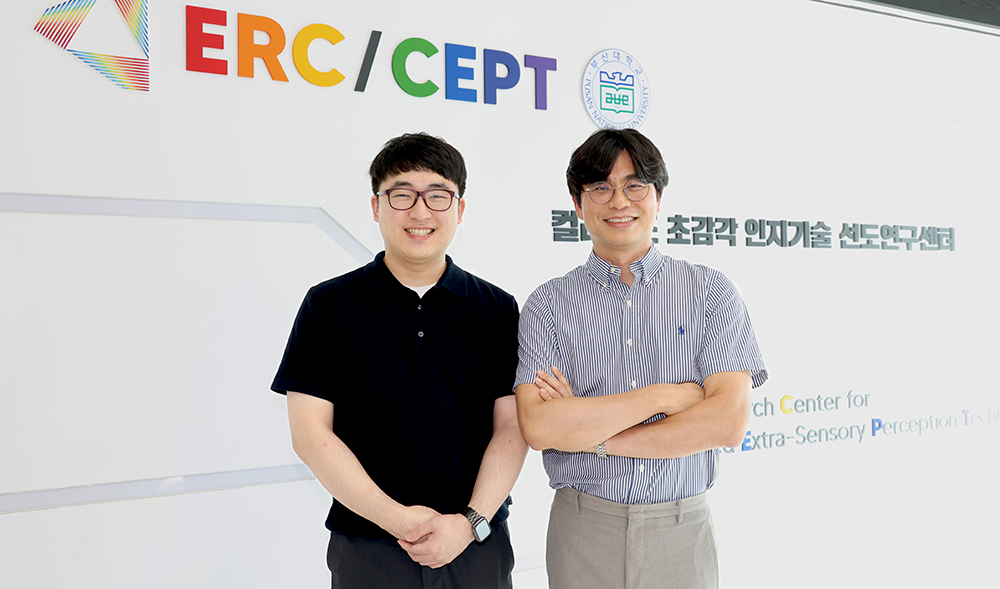
* 연구진 사진: 오른쪽부터 엄태중 교수, 이용재 연구교수.
[Abstract]
Professor Eom Tae Joong's research team, affiliated with the Division of Advanced Convergence Studies and the Leading Research Center for Color-Modulated Extrasensory Perception Technology at Pusan National University, has developed a photoacoustic imaging technique for more stable quantification of blood oxygen saturation (sO₂), in collaboration with Caltech's Professor Lihong V. Wang.
The team's Frequency-Domain Photoacoustic Microscopy (FD-PAM) simultaneously irradiates two wavelengths, 488 nm and 515 nm, and separates them using distinct frequency signals via two acousto-optic modulators. This overcomes the temporal mismatch problem common in conventional sequential-wavelength systems, particularly when imaging moving biological tissue.
Validation tests measured oxygen saturation in oxygenated, mixed, and deoxygenated blood samples, with accuracy within ± 1.7%, confirming the system's ability to precisely distinguish different oxygenation states.
Professor Eom noted the study combines Pusan National University's FD-PAM technology with Caltech's expertise in photoacoustic imaging, and expressed plans to further develop the technique into a high-reliability biomedical imaging tool for evaluating drug response and treatment efficacy.
The study's first author is Research Professor Yong-Jae Lee, with Professor Eom as corresponding author and Professor Lihong V. Wang as co-author.
- Authors (Pusan National University)
· First author: Yong-Jae Lee (Engineering Research Center for Color-modulated Extra-sensory Perception Technology)
· Corresponding author: Tae Joong Eom (School of Transdisciplinary Engineering, Engineering Research Center for Color-modulated Extra-sensory Perception Technology)
- Title of original paper: Frequency-Domain Photoacoustic Microscopy with Resonant Transducer and Interferometric Modulation for High-reliability sO₂ Imaging
- Journal: Photoacoustics
- Web link: https://doi.org/10.1016/j.pacs.2026.100834
- Contact e-mail: eomtj@pusan.ac.kr
-
입자 접착력 70배, 효율 최대 30%·수명 2배 향상
응용화학공학부/_UPLOAD/IMAGE/Board/68/2026/9/gcfbPoC6gpie7FDT.JPG응용화학공학부김채빈 교수팀, 동적 결합 고분자 기반 ‘흡수형’ 공기 필터 개발입자 접착력 70배, 효율 최대 30%·수명 2배 향상
응용화학공학부 김채빈 교수팀이 중앙대와의 공동연구를 통해 동적 결합 고분자 기반 점탄성 접착층을 활용해 미세먼지를 필터 내부로 ‘흡수’할 수 있는 차세대 공기 필터 기술을 개발했다. 이번 기술은 기존 공기 필터 대비 입자 접착력과 필터 효율, 수명을 동시에 향상시켜 고성능·저에너지 공기 정화 기술의 새로운 가능성을 제시했다.
기존 공기 필터는 주로 입자를 필터 표면에 붙잡는 방식으로 작동한다. 그러나 이때 입자와 필터 사이의 부착력은 분자 간에 작용하는 약한 반데르발스 힘에 의존하는 경우가 많아, 포집된 입자가 다시 떨어져 나가는 재비산(再飛散) 문제가 발생할 수 있다. 또한 필터 사용 기간이 길어질수록 압력 손실이 증가해 에너지 소비가 커지고, 필터 수명이 짧아지는 한계도 있었다.
이러한 문제를 해결하기 위해 액체 코팅 필터가 제안되기도 했지만, 액체가 기류 속에서 불안정해지는 현상인 Plateau-Rayleigh 불안정성, 액체 유출, 2차 오염 등의 문제가 남아 있었다.
【김채빈 교수】연구팀은 이를 극복하기 위해 이민 결합(탄소·질소 이중결합 구조) 기반의 동적 공유결합 네트워크, 즉 CAN 구조를 갖는 점탄성 접착층 DIBA를 설계했다. 이 소재는 고체처럼 구조적 안정성을 유지하면서도 액체처럼 유동성을 나타내는 점탄성을 갖는다. 이를 공기 필터에 적용하면 입자가 필터 표면에 닿는 순간 미세한 액체 다리 구조인 메니스커스가 형성되고, 이로 인해 강한 모세관력(capillary force)이 발생한다.
특히 이번 기술은 동적 결합 교환을 통해 입자를 고분자 내부로 자발적으로 흡수하도록 해 기존 필터에서 포집된 입자가 표면을 덮을수록 접착 성능이 떨어질 수 있었던 것과 달리, 입자가 내부로 이동하면서 새로운 접착 표면을 지속적으로 유지할 수 있다.
연구 결과, 해당 필터는 기존 방식에 비해 입자 접착력이 약 70배 증가했으며, 필터 효율은 10~30% 향상됐다. 또한 압력 손실 증가 없이 성능이 개선됐고, 필터 수명은 약 2배 이상 연장됐다. 초고속 기류, 즉 20m/s 이상의 환경에서도 안정적으로 작동했으며, 포집된 입자의 재비산을 효과적으로 억제하는 것으로 확인됐다. 다방향 기류 환경에서도 높은 포집 성능을 유지해 실제 산업 환경과 실외 공기정화 시스템 등 다양한 응용 가능성을 보였다.

【모세관력 기반 입자 흡수 기능을 갖는 동적 공유결합 접착 고분자 소재】
(a) 쉬프 염기 반응을 통해 형성되는 이민 결합 기반 동적 가교 구조 모식도.
(b) 공유결합 네트워크(좌)와 내부 물 분자에 의해 매개되는 동적 공유 결합 교환(우).
(c,f) 실리카 미세입자(5–50 µm)가 부착된 동적 가교 고분자(DIBA, 두께 ∼550 µm)와 영구 가교 PDMS(∼560 µm)의 비교 사진
(d,g) 표면 및 단면 SEM 이미지로, 동적 가교 결합 고분자(DIBA)는 입자가 내부까지 흡수된 반면 PDMS는 표면 부착에 그침을 확인.
(e,h) 점탄성 DIBA의 지속적 입자 포집 및 내부 흡수 메커니즘과, PDMS의 제한적 표면 접착 거동 비교.
이번 연구는 고성능 공기청정기, 산업용 필터, 데이터센터 공조 시스템, 자동차 필터, 실외 공기정화 장치 등에 활용될 수 있을 것으로 기대된다. 특히 압력 손실을 높이지 않으면서 필터 효율과 수명을 동시에 개선할 수 있어, 저에너지·장수명 친환경 필터 기술 구현에 기여할 전망이다.
김채빈 응용화학공학부 교수는 “흔히 필터는 입자를 표면에 붙잡아 두는 장치로 인식되지만, 이번 연구에서는 포집된 입자를 소재 내부로 흡수·수용하는 새로운 작동 메커니즘을 제시했다”며 “이는 필터 표면의 막힘과 재비산 문제를 줄이고, 고효율과 장수명을 동시에 구현할 수 있어 차세대 공기 정화 기술의 중요한 전환점이 될 것으로 기대한다”고 밝혔다.
부산대·중앙대 공동연구로 수행된 이번 연구는 한국연구재단 지원을 받았다. 응용화학공학부 김채빈 교수가 교신저자, 윤여명 박사과정생과 최경환 석박통합과정생이 공동저자로 참여했다.
해당 논문은 세계적 학술지 『Advanced Materials』 7월 27일자에 게재됐으며, 연구의 우수성을 인정받아 표지논문(front cover)으로 선정됐다.
- 논문 제목: A Super-Adhesive Air Filter With Capillarity-Mediated Spontaneous Particle Absorption via Dynamic Bond Exchange(동적 결합 교환 기반 모세관 작용을 이용한 자발적 입자 흡수형 초고접착 공기 필터)
- 논문 링크: https://doi.org/10.1002/adma.74232
※ 용어 설명
- 동적 결합: 결합이 끊어지고 다시 형성될 수 있어 재배열이 가능한 공유결합
- 점탄성: 고체와 액체의 성질을 동시에 가지는 물성
- 모세관력: 액체가 입자 표면을 적시면서 발생하는 강한 인력
- 동적 공유결합 네트워크, CAN: 공유결합으로 이루어진 고분자 네트워크이지만, 결합 교환을 통해 구조 재배열이 가능한 소재 시스템
- 메니스커스: 액체가 고체 표면이나 입자 사이에서 굽어진 계면을 형성하는 현상으로, 강한 접착력을 유도할 수 있다.
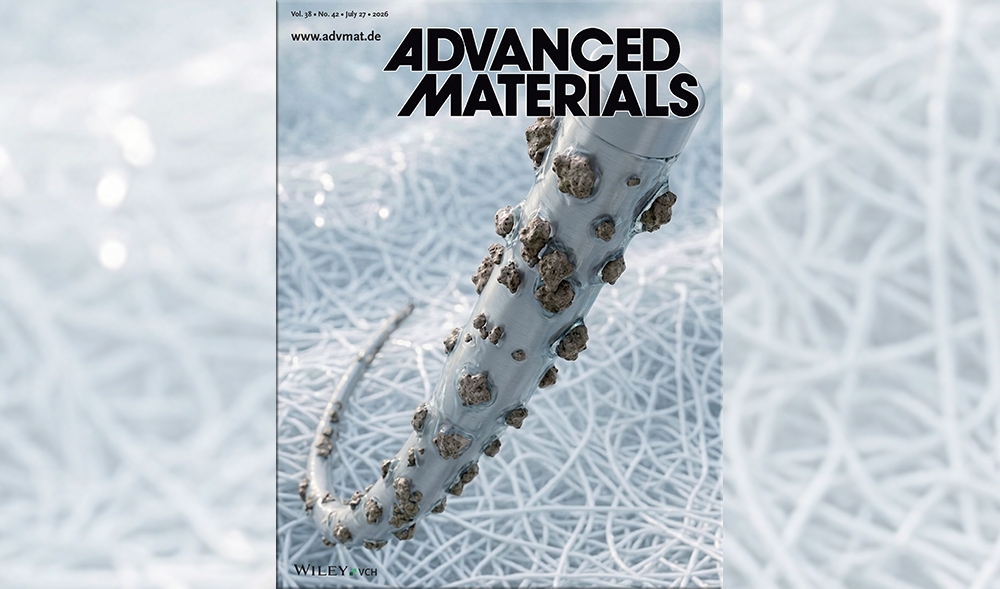
* 상단 이미지: 『Advanced Materials』 표지논문 이미지.
[Abstract]
A strategy to coat a thin liquid film over substrates enables strong particle adhesion via capillary force. However, the practical utility of a liquid film is hindered by inherent fluid instabilities, including the Plateau-Rayleigh instability, interfacial dewetting, and drainage. Here, we introduce dynamically crosslinked adhesive films that maintain an elastic network to ensure structural integrity while enabling viscous, capillarity-driven particle adhesion. Polydimethylsiloxane with an imine crosslinked network is applied as a viscoelastic adhesive. While the elastic nature allows for stable and thick films, it remains sufficiently viscous to form a meniscus upon particle contact; this generates a micro-Newton scale, strong capillary force. When applied to air filters, which typically rely on nano-Newton scale van der Waals adhesion, the dynamically crosslinked adhesive improves filtration performance and suppresses particle resuspension. Rather than only retaining particles on the surface, the adhesive layer with dynamic imine bonds actively absorbs particles into the matrix, which then exposes a fresh sticky surface for sustained filtering and prolongs the increase in pressure drop by filtering. Therefore, operational lifetime of the filter is extended compared to conventional filters, even with more effective filtration. These unique particle capturing characteristics of a stable dynamic bond adhesive layer not only exhibits outstanding filtration performances, but also proposes a new paradigm of air purification technologies.
- Author (Pusan National University): Chae Bin Kim (School of Chemical Engineering)
- Title of original paper: A Super-Adhesive Air Filter With Capillarity-Mediated Spontaneous Particle Absorption via Dynamic Bond Exchange
- Journal: Advanced Materials
- Web link: https://doi.org/10.1002/adma.74232
- Contact e-mail: cbkim@pusan.ac.kr
-
베트남·중국·한국 자료 통해 베트남 농업 발전 과정과 특징 탐구
사학과/_UPLOAD/IMAGE/Board/68/2026/8/6N1HqfI24xkLbTH5.JPG사학과최덕경 명예교수, 전근대 베트남 농업 종합 연구서 『베트남 농업사』 발간베트남·중국·한국 자료 통해 베트남 농업 발전 과정과 특징 탐구
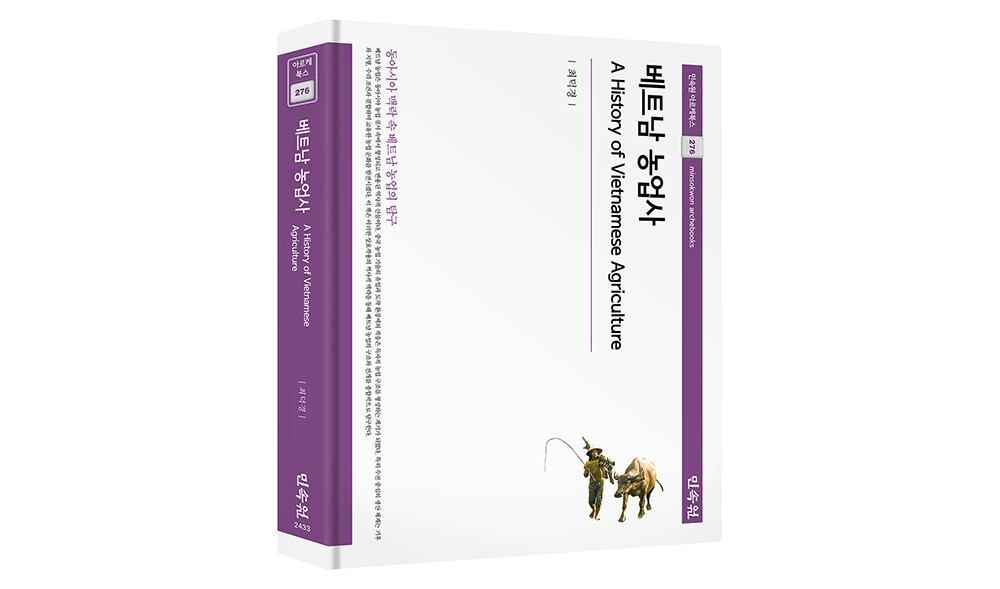
사학과 최덕경(사진) 명예교수가 수십 년간 집적해 온 중국농업사 연구를 기반으로 베트남 농업 통사를 다룬 저서 『베트남 농업사』(민속원, 2026.4.16.)를 발간했다.『베트남 농업사』는 전근대 베트남 농업을 종합적으로 고찰한 연구서로, 이와 같은 범주와 수준에서 농업사를 체계적으로 다룬 사례는 현재까지 아시아는 물론 서구 학계에서도 거의 찾아보기 어렵다. 기존 연구가 주로 쌀 생산이나 특정 작물에 한정돼 있었던 데 비해, 이 책은 농업을 사회 구조와 생활 세계 전반 속에서 통합적으로 분석하고자 한다.
이와 같은 작업이 가능했던 배경에는, 중국 고대 농업사를 오랫동안 연구해 온 필자의 학문적 기반과 더불어, 중국과 유사한 역사적 경험을 지닌 한국 측 자료의 활용, 그리고 베트남에 대한 지속적인 관심과 문제의식이 자리하고 있다. 이는 베트남 농업사를 이해하는 데 있어 중국 농업사뿐 아니라 한국을 포함한 동아시아 농업사 전반에 대한 비교사적 시각이 필수적임을 시사한다.
베트남 농업은 중국의 영향을 받으면서도 자국의 풍토와 환경에 맞게 재구성된 독자적 체계로 발전했다. 이 책은 이를 농업사 관점에서 처음 체계화했다. 그동안 베트남 농업을 구조적으로 이해할 수 있는 기초 텍스트가 거의 부재했던 연구 환경 속에서 농업과 농민의 삶을 중심으로 베트남 사회를 재구성하고자 시도했다.

【최덕경 교수】저자는 수전(水田)·한전(旱田) 농업을 핵심 축으로, 벼농사의 구조와 품종 선택, 파종·수확 방식, 밭작물·잡곡 재배의 기능과 한계를 분석했다. 특히, 홍수·범람·조수의 영향을 지속적으로 받는 저습지 환경 속에서 베트남 농업이 생산량 극대화보다 안정적 수확과 위험 분산을 중시했음을 규명한다. 기후 예측과 농사 일정, 수목·화훼 재배, 섬유·염색, 비료·시비 체계, 촌락 공동체와 토지 구조까지 농업을 둘러싼 생활 세계를 입체적으로 고찰했다.
또한, 베트남 농업을 동아시아 농업사 속에 위치시키며 중국뿐 아니라 기후 변동과 농업 위험에 대응해 온 한국의 역사적 경험과 비교해 그 특수성과 보편성을 함께 조명하고, 조숙도 벼·섬유작물·저습지 농법 등에서 베트남이 중국과 주변 지역에 미친 영향까지 검토함으로써 동아시아 농업의 상호작용을 새롭게 이해할 수 있는 관점을 제시했다.
최덕경 명예교수는 “『베트남 농업사』는 베트남 연구의 공백을 메우는 기초 연구서일 뿐만 아니라, 동아시아 농업사를 보다 넓은 시야에서 다시 바라보게 만드는 계기를 제공해 줄 것”이라고 말했다.
[Abstract]
A History of Vietnamese Agriculture
Choi Deok-kyung, Emeritus Professor of History at Pusan National University, has recently published A History of Vietnamese Agriculture (Minsokwon, April 16, 2026), a comprehensive study of premodern Vietnamese agriculture grounded in decades of research on Chinese agrarian history.
The book offers a rare, systematic synthesis that goes beyond crop-specific studies to analyze agriculture within broader social and everyday contexts. Drawing on Chinese agrarian scholarship, Korean historical experience, and sustained engagement with Vietnam, it emphasizes the necessity of a comparative East Asian perspective.
It argues that Vietnamese agriculture, while influenced by China, developed into a distinct system adapted to local environmental conditions. Focusing on wet-rice and dry-field farming, the study examines crop selection, cultivation methods, and the environmental constraints on upland crops. It highlights how agriculture in flood-prone lowlands prioritized stability and risk management over maximum yield.
The work also explores climate knowledge, arboriculture, fiber production, fertilization, and village land systems, reconstructing the agrarian life-world in a holistic way. By situating Vietnam within East Asian agricultural history, it further shows how Vietnamese practices—such as early-ripening rice, fiber crops, and wetland farming—contributed to regional agricultural interactions.
Choi notes that the book not only fills a major gap in Vietnamese studies but also provides a new perspective for understanding East Asian agriculture as a whole.
- Author: Choi, Dukkyung (Department of History, Pusan National University)
- Contact e-mail: dkhistory@daum.net
-
다제내성 그램음성균 잡는 '신규 항균 플랫폼' 개발
화학과/_UPLOAD/IMAGE/Board/68/2026/8/k0Zc0bcgQAxoeSMR.JPG화학과김광선 교수팀 "세균 스스로 방어벽 허물게 유도해 기존 항생제 효능 높인다"다제내성 그램음성균 잡는 '신규 항균 플랫폼' 개발전 세계 보건을 위협하는 ‘다제내성 그램음성균’에 맞서 부산대 연구팀이 세균의 방어 체계를 역이용하는 혁신적인 항균 전략을 제시해 새로운 치료 패러다임의 가능성을 열었다. 여러 항생제에 버티는 내성과 견고한 외막 구조를 동시에 지닌 다제내성 그램음성균은 전 세계적으로 치료가 가장 까다로운 병원성 세균 중 하나로 꼽힌다.
화학과 김광선 교수 연구팀은 대장균의 유전 조절 시스템에서 유래한 펩타이드 ‘TimP’를 활용해 그램음성균의 외막 구조를 재배치하고, 이를 통해 최후의 보루 항생제로 불리는 ‘폴리믹신(Polymyxin)’의 항균 효능을 높이는 데 성공했다.
강한 항생제를 개발하는 데 집중하기보다, 세균이 스스로 외막 방어벽을 무너뜨리도록 유도해 기존 항생제의 효과를 끌어올리는 방식이어서 주목된다.
다제내성 그램음성균은 외막이라는 강력한 물리적 장벽을 갖고 있어 기존 항생제는 물론 신규 항생제에도 높은 저항성을 보이는 등 신약 개발 속도가 세균 진화 속도를 따라잡지 못하는 상황에 직면했다. 특히 폴리믹신은 그램음성균의 외막을 직접 공격하는 핵심 약물이지만, 내성이 빠르게 나타나고 독성이 높아 임상 활용에 한계가 있었다.
이를 보완하기 위한 병용 요법(Combination Therapy, 서로 다른 기전을 가진 항생제들을 섞어 투여) 연구도 이어져 왔으나, 약동학적 불일치와 세포 독성, 낮은 세균 침투 효율, 내성 유도 가능성 등으로 실제 적용에는 기술적·임상적 어려움이 따랐다.
연구팀은 이러한 한계를 넘기 위해 대장균 sRNA 과발현 라이브러리 스크리닝을 수행하던 중 폴리믹신의 효능을 증가시키는 sRNA인 ‘RyfA’를 발굴했다. 이어 이 sRNA 유전자에서 유래한 펩타이드 TimP가 동일한 기능을 한다는 사실을 확인했다.
특히 TimP가 과발현된 조건에서는 세균이 TimP를 실은 나노 크기의 세포밖 소포체(EV)를 과량 생성하는 것으로 나타났다. 이 EV는 세균 외막 구조를 변화시켜 폴리믹신이 세균 내부로 침투할 수 있는 ‘통로’를 열어주는 전달자 역할을 하는 것으로 분석됐다.
연구팀은 AlphaFold 기반 결합 예측과 다양한 표현형 분석을 통해 TimP를 포함한 생체 분자가 세균 외막 단백질인 LamB와 상호작용한다는 점도 규명했다. 이를 통해 기존에는 견고하게 유지되던 외막 구조가 물리적으로 재구성되고, 결과적으로 폴리믹신에 대한 감수성이 높아지는 메커니즘을 확인했다. 이 같은 작용이 종 보존성(그램음성균이 공유하는 공통 메커니즘)을 가진다는 점도 함께 제시됐다.
연구팀은 이 메커니즘을 실제 치료 전략으로 확장해 폴리믹신과 TimP를 동시에 탑재한 EV 플랫폼 ‘PMB@TimP EV’를 구축했다. 한국생명공학연구원의 공동연구를 통해 해당 플랫폼이 낮은 농도의 폴리믹신만으로도 다제내성 그램음성균에 대한 항균 효능을 높이면서 안전성까지 확보할 수 있음을 확인했다.

【TimP 기반 폴리믹신(Polymyxin) 감수성 조절 작용기전 및 치료제 개발】
이번 연구의 핵심은 항생제 치료의 접근법 자체를 바꿨다는 데 있다. ‘어떻게 항생제를 섞을까’가 아니라 ‘어떻게 세균을 무너뜨릴까’라는 근본적인 질문에 답을 제시한 것이다.
기존 연구들이 어떤 항생제를 어떻게 조합할 것인지에 초점을 맞췄다면, 이번 성과는 세균의 유전적 조절 시스템을 역이용해 스스로 방어 체계를 해제하도록 만들고, 그 틈을 통해 기존 항생제가 더 효과적으로 작동하도록 했다.
김광선 교수는 “기존 항생제 내성 연구가 주로 항생제 자체의 변형에 집중했다면, 이번 연구는 다제내성균의 복잡한 외막 구조를 정밀하게 제어해 세균 고유의 단백질 시스템을 역이용함으로써 항생제 투과성을 높였다는 점에서 차별화된다”고 설명했다. 이어 “TimP 펩타이드를 포함한 EV 기반 약물 전달체와 결합하면 독성이 강한 항생제의 사용량은 줄이면서 치료 효과는 극대화할 수 있다”며 “신규 항생제 개발이 지체되는 상황에서 가용 자원의 효율을 높여 의료 현장의 공백을 메우는 데 기여할 수 있을 것”이라고 내다봤다.
이번 연구 성과는 한국연구재단의 ‘국가아젠다 기초연구’ 지원을 받아, 화학과 김광선 교수가 교신저자, 조혜진 박사가 제1저자로 한국생명공학연구원의 공동연구로 수행됐다. 연구의 학술적 가치와 혁신성을 인정받아, 약학 및 약물 내성 분야 세계 최고 권위지인 『Drug Resistance Updates』 7월호에 게재됐다.
- 논문 제목: The sRNA-encoded peptide TimP rewires the Escherichia coli envelope via LamB to sensitize bacteria to polymyxins (TimP 기반의 LamB 조절을 통한 폴리믹신 감수성 증가 및 외막 재설계 전략)
- 논문 링크: https://www.sciencedirect.com/science/article/pii/S1368764626000579
* 상단 연구진 사진: 왼쪽부터 김광선 교수, 조혜진 박사.
[Abstract]
The rise of multidrug-resistant (MDR) Escherichia coli has marginalized last-line polymyxins (PMs) owing to evolving resistance and narrow therapeutic windows. Revitalizing these agents requires the identification of novel regulatory circuits governing the integrity of the gram-negative envelope. In this study, we identified TimP, a stress-responsive peptide, and demonstrated that intracellular overexpression (TimP+), synthetic peptide (FT-Pep), and biogenic TimP+-derived extracellular vesicles (TimP EVs) exhibited equivalent functionality in sensitizing E. coli to PMs with PM-mediated phenotypes. Mechanistically, TimP in E. coli initiates coordinated envelope remodeling by interacting with porin LamB via a specific N21TimP-R134 LamB molecular interface. Furthermore, the TimP-TimR/TimP-LamB interaction is functionally conserved in both E. coli and Salmonella. Pharmacokinetic profiling and spatiotemporal imaging of FT-Pep revealed a predictable physiological disposition across major organs and gradual systemic clearance over 24 h, with no evidence of pathological sequestration. Hepatic and immunological assessments confirmed that FT-Pep or TimP EVs were systemically inert, with serum pro-inflammatory markers and liver enzymes remaining within baseline physiological ranges. Exploiting these beneficial effects, we engineered polymyxin B (PMB)@TimP EVs, which exhibited enhanced bactericidal activity, improved pH stability, and negligible mammalian cytotoxicity compared with free PMB. In a murine sepsis model, PMB@TimP EVs demonstrated clear in vivo efficacy at an equivalent dose, maintaining survival when free PMB failed. Collectively, this study identified TimP as a conserved target and demonstrated a Trojan-horse drug delivery system capable of restoring the efficacy of PM against MDR gram-negative pathogens.
- Authors (Pusan National University, Department of Chemistry)
· First author: Hyejin Cho
· Corresponding author: Kwang-sun Kim
- Title of original paper: The sRNA-encoded peptide TimP rewires the Escherichia coli envelope via LamB to sensitize bacteria to polymyxins
- Journal: Drug Resistance Updates
- Web link: https://www.sciencedirect.com/science/article/pii/S1368764626000579
- Contact e-mail: kwangsun.kim@pusan.ac.kr